
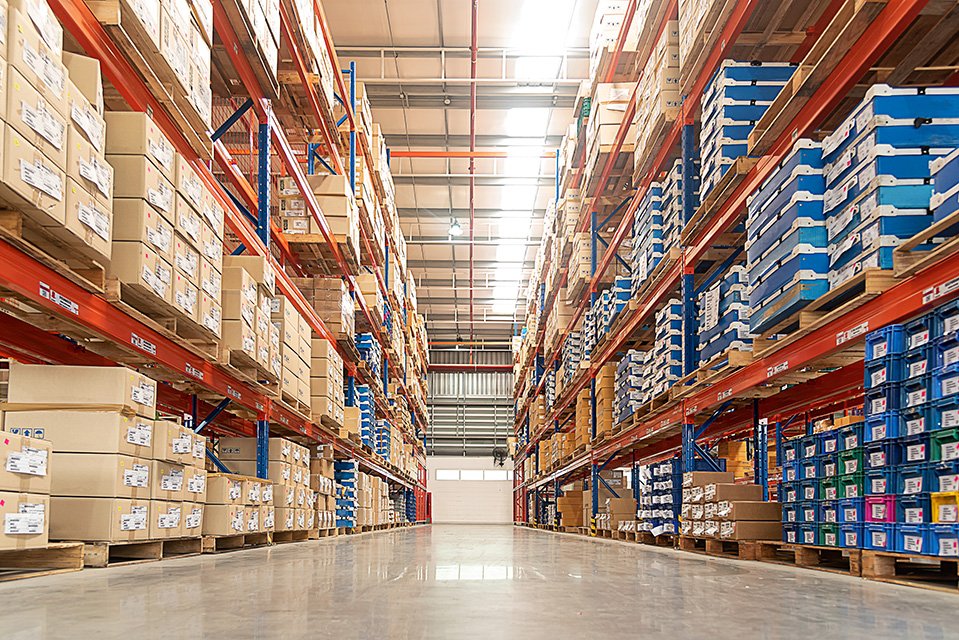
Warehouse Construction in Santa Fe and Northern New Mexico
Goods reach northern New Mexico mostly on trucks, and the warehouse that receives them has to make that arrival easy. The BNSF line through Glorieta carries Amtrak's Southwest Chief once daily each way and, as of 2025, very little freight, so a storage building here is judged almost entirely by its relationship to the road. That makes siting the first decision and the dock layout the second, with the structure itself following from both.
We build warehouses of the sort that suit this metro: moderate in size, built for local and regional distribution, contractor supply, building materials, equipment storage and the inventory of the businesses that serve a city of visitors and state workers. A warehouse of this kind has to be dependable more than it has to be dramatic, with a slab that holds, a roof that sheds snow, a dock where trucks can back in and a building that has an honest chance of getting through review without argument.
The kinds of warehouse we are asked to build
Most requests fall into a few groups. Contractor and trade warehouses combine storage with an office and a yard. Light distribution buildings hold palletized goods for delivery within the region. Equipment storage buildings protect vehicles, tools and materials from weather. Each has different clear height, dock needs and floor loads, and we ask about the first few before sketching the second.
Owners often come from related building types as well. Our notes on warehouse buildings go through the layout in more detail, and owners with larger operations might look at distribution center construction or cold storage construction when the product or volume calls for it.
How we plan a warehouse around the truck
We start the layout with the truck. The type of trailer, the turning radius, the number of doors and the staging area determine how deep the apron must be and how the site will drain. Only after that do we shape the building: column spacing that suits the racking, clear height that gives you the cube you pay for, and a floor flat enough for the lift trucks you intend to use.
Slabs are the part of a warehouse that fails most visibly, so we are careful with them. Subgrade preparation, vapor control, joint spacing, reinforcement and curing all affect flatness and durability. We pour in conditions where the concrete can cure properly, and in cold weather we protect it. Owners who want a faster structure can consider tilt-wall construction, which suits the same program.
Roads and sites we work along
The central spine is I-25. US 84 and US 285 meet it on the south side of Santa Fe, where the freeway merges with northbound I-25 at exit 282A, and NM 599 connects to I-25 at exit 276 on the border of La Cienega. The Santa Fe County/NM 599 Rail Runner station sits in the median of I-25 at that same interchange. Warehouses located near these junctions benefit from highway access without having to push trucks through the center of town.
To the northeast, Las Vegas is bypassed by I-25, and Interstate 40 lies 55 miles to the south via US 84 from there, which gives an owner in Las Vegas a different geography from one in Santa Fe. To the south, Lamy and Glorieta sit along rail and highway corridors where the questions of land and services differ from those in town. We help owners judge those tradeoffs.
What reviewers look at
A warehouse is reviewed for occupancy and storage hazard, allowable area, sprinkler requirements, egress, accessibility and energy compliance. The 2021 New Mexico Commercial Building Code, which adopts the 2021 International Building Code as amended, applies, as does the 2021 International Fire Code with City of Santa Fe amendments inside the city. High-piled storage can trigger special fire protection, and we ask early about what you intend to store.
Drainage and stormwater are also a recurring review item, since a large roof and paved apron produce runoff that must be managed. Our work in site development and utilities covers detention, grading and the extensions of services. Where the parcel is near a historic area or an archaeological site, the schedule must allow time for clearance.
Keeping the yard safe during construction and afterwards
During construction, deliveries, cranes and concrete trucks share a yard with workers, so we mark traffic routes, keep spotters at the gate and brief every trade about the plan. After occupancy, the same attention to circulation matters: separation between pedestrians and lift trucks, visible dock doors with lights and restraints, and clear fire lanes.
We also think about winter. A dock apron that holds ice or a ramp that is steep enough to be hazardous in a freeze will cause trouble for years. We design slopes, drainage and snow storage so that the yard works in January as well as in July.
A schedule that respects the review
Warehouse schedules are driven by permits, by long-lead items such as dock equipment, overhead doors and roofing, and by weather. We build in time for the board or the county, set the pour dates after the foundation, and order the dock equipment early. The shell can often be completed in a few months once the foundation is in, though the interior work depends on racking and mechanical needs.
For owners who are leasing to tenants, we can phase the project so a portion is ready for early occupancy. This works best when utilities and fire protection are laid out to serve each bay independently. Public and institutional owners should also review how we approach logistics and distribution users in the region.
Begin with the road and the dock
Share the parcel, the product and the truck size, and we will propose a layout and a budget range. If you are weighing a fulfillment operation, see how fulfillment and logistics centers differ from a warehouse.
Questions Owners Ask
Where in the Santa Fe metro do warehouses make sense?
Near the I-25 junctions and the NM 599 interchanges, where truck access is direct and the land is usually zoned for commercial or light industrial use. Inside the historic districts, a warehouse is not a realistic prospect. We test a parcel for zoning, utilities and access before an owner commits.
How tall should the warehouse be?
Clear height depends on racking and the pallets you store. Many regional warehouses work well at moderate clear heights, and higher clear heights add cost in walls, sprinkler design and sometimes snow load. We compare options for your inventory rather than assuming the tallest is best.
What does it cost to add a rail connection?
In this region, usually a poor bet. The line through Glorieta carries one daily Amtrak train each way and little freight, and the Santa Fe Southern Railway line to Lamy connects to BNSF but runs as an excursion route. Most warehouses here rely on trucks, so we put the investment into the dock instead.
Can we build in phases?
Yes. A common approach is to build the full slab and utilities, then add shell bays as tenants arrive. Phasing keeps cash outlay down but needs a layout that allows later bays to attach cleanly. We plan the end walls and utilities so expansion does not require demolishing what is already built.