
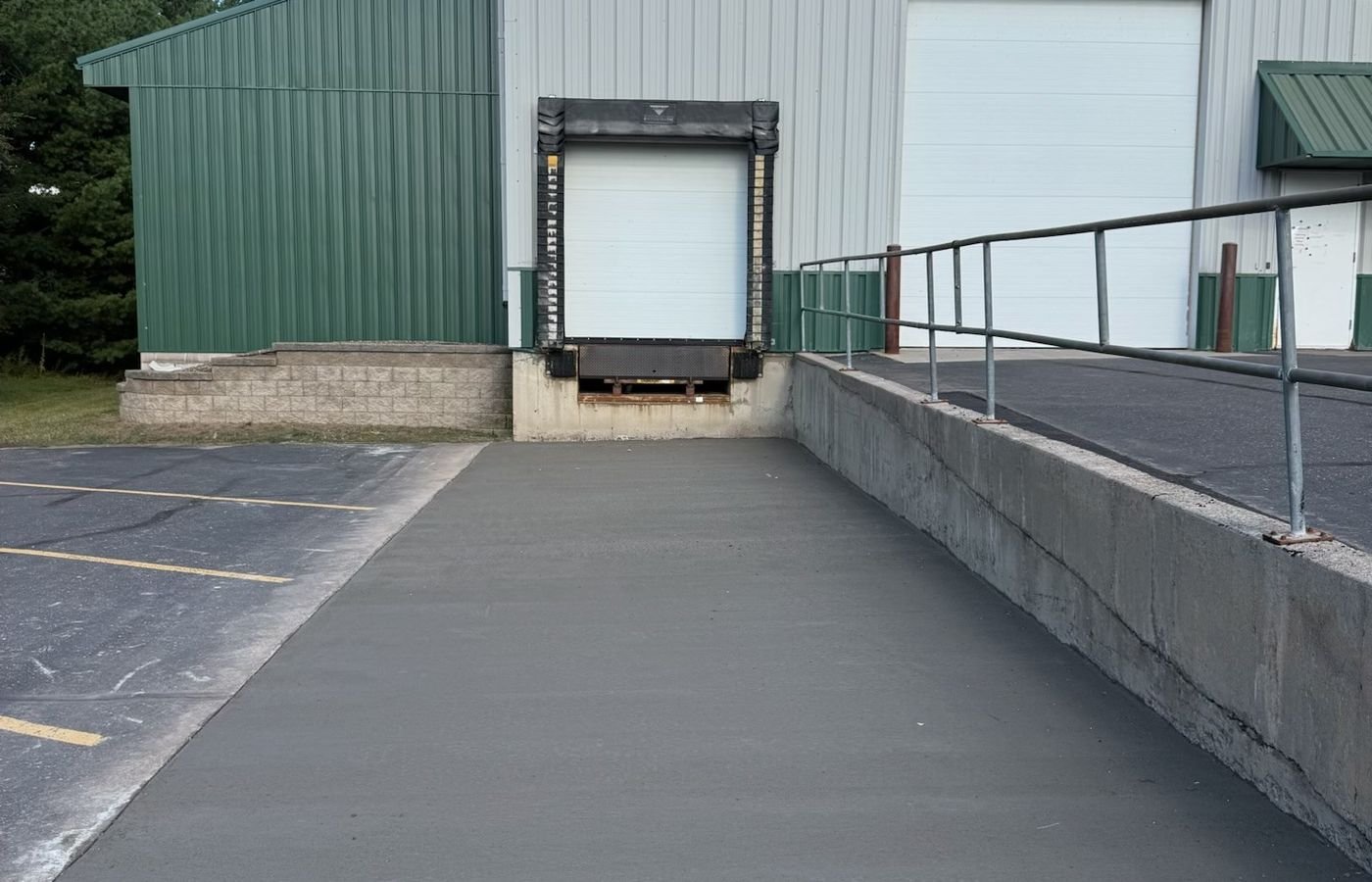
Truck Courts and Dock Aprons Built for Northern New Mexico Freight
A fifty-three foot trailer swings a long way when it backs toward a dock, and the pavement it swings across is asked to carry more weight, in a narrower pattern, than almost anything else on a commercial site. Truck courts and dock aprons are where a building meets the road, and they fail early when they are treated as an afterthought to the slab inside.
We build concrete dock aprons, heavy-duty asphalt and concrete truck courts, trailer parking, drive lanes, dolly pads and the pits and ramps at loading doors. In the Santa Fe region these are usually modest facilities, a few doors serving a distribution tenant, a supplier, a contractor yard or a public works depot, but even a modest dock carries heavy loads, and it works only when the geometry is right.
We spend our time on the unseen parts: subgrade preparation, base thickness, jointing, dowels and the slope that keeps meltwater from freezing in front of a door. Those are the details that decide whether a court is still flat after ten winters.
The parts of a working dock
The apron is normally thick concrete, reinforced and doweled across joints, because trailers load the same strip of pavement again and again and the landing gear of a parked trailer concentrates weight on a few square feet. Behind it, the dock face has its levelers, bumpers, seals and pits, each of which needs formed concrete to the manufacturer's tolerances. Beyond the apron, the court itself may be concrete or heavy-duty asphalt, depending on loads, budget and owner preference.
We also build the marking, signage, bollards and wheel stops that keep operations orderly. Any slab that connects inside to outside, such as the one covered in our commercial concrete floors work, is coordinated with the apron so that the joint at the door does not become a bump for forklifts.
Highways, spurs and where trucks actually come from
Freight into this region moves by road. The BNSF line through Glorieta carries Amtrak's Southwest Chief once daily in each direction and very little freight as of 2025, so a truck court here is almost always the only link between a building and its supply. In Las Vegas, I-25 bypasses downtown and unsigned US 85 follows Interstate 25 Business for about 4 miles through town, while Interstate 40 lies 55 miles to the south via US 84, which defines how long a haul will be for deliveries heading east and west.
Around Santa Fe, the NM 599 bypass was completed in November 2000 and runs 14.019 miles, and the parcels beside its interchanges are where owners look for larger truck courts. A site on the NM 599 bypass starts with entrance geometry, since a driveway that suits cars may not suit a loaded tractor-trailer.
Keeping trucks, forklifts and people apart
A dock is a place where heavy machinery and pedestrians meet, and the pavement layout can reduce risk before anyone speaks of training. We favor one-way circulation where there is room, separate walks and car parking from the truck court, and mark crossings clearly. Sight lines at the corner of the building, the height of lighting and the location of bollards all matter.
During construction we protect the active site as carefully as the finished one. Deliveries on an occupied property are scheduled around tenant operations, flaggers direct traffic, and temporary barriers keep trucks off the area where concrete is curing. Owners who run a truck terminal or cross-dock know how important it is to keep doors usable during work, and we plan phases so that a portion of the apron remains in service.
Subgrade first, then thickness, then joints
The soils report tells us whether the subgrade can carry the loads or needs stabilizing, and we proof-roll the subgrade before any base is placed. Base thickness is set by the engineer for the expected truck traffic, and concrete thickness and reinforcing follow. Joints are laid out so that panels are roughly square, dowels are aligned, and saw cuts happen early enough to prevent random cracking.
Drainage is built into the geometry. Aprons slope away from doors, inlets sit where water can reach them without crossing wheel paths, and low points are kept clear of the swing of trailers. For storm management beyond the court, we work with the crews who handle stormwater and drainage so that a thaw does not send water onto a neighbor's property or back toward the building.
Winter, snow and the long shadow of a building
At this elevation, ice is one of the real hazards of a dock. A building's north face may hold shade and frozen meltwater until spring, so we pay attention to slopes, to the placement of downspouts and to heat tracing where it is warranted. Snow storage is planned as well, because plowed snow piled on a dock apron simply refreezes.
Developers assembling a distribution program should consider how truck courts fit with the larger facility. A distribution center and the logistics and distribution operators who use one both begin with the court, since depth, turning radius and trailer count shape the building as much as the other way around.
Start with the truck, not the building
Tell us the largest vehicle that will visit, how often it will come and how many doors you expect to use, and we will describe the court that suits the site. A short conversation about trailer counts now can save a major rebuild later.
Questions Owners Ask
Should a truck court be concrete or asphalt?
Concrete resists rutting under parked trailers and heavy turning loads, so it is commonly used at dock aprons and entrance throats. Asphalt costs less up front and is easier to repair, which is why it often serves for drive lanes and parking. Many sites use both. We price each option for your traffic and explain what maintenance each will need.
How much room does a trailer need to turn?
More than most people assume. A standard trailer needs a deep apron and a wide turning path in front of the doors, and the court has to be laid out for the longest vehicle that will visit. We draw turning paths early and test them against the site boundary and parking.
What causes dock aprons to fail early?
Poor subgrade, insufficient thickness, missing dowels, standing water and joints that open and pump fines are the usual causes. In cold regions, freeze-thaw cycles worsen every one of them. Addressing each in the design and building them carefully is cheaper than repairing a damaged apron while trucks are waiting.
Can the work be done while the warehouse operates?
Often, with phasing. We divide the apron into sections, keep some doors in service, and schedule concrete placement for off-hours. The cost is more mobilization and coordination, and the benefit is that the tenant keeps shipping. We discuss the trade-off openly.
How do we plan for future trailer parking?
Reserve land and drainage for it from the start, even if you only build part now. Adding stalls later is far easier when the grading, utilities and lighting have already been sized for them.