
Stormwater and Drainage Work in Santa Fe and the Rio Grande Valley
Rain in northern New Mexico tends to arrive all at once. A dry arroyo can run brown and fast for twenty minutes in July and be quiet again by supper, which is why drainage on a commercial site cannot be treated as a final detail. Water decides where the pavement slopes, where the building sits and how long the landscaping survives, and we plan for it from the first day on the parcel.
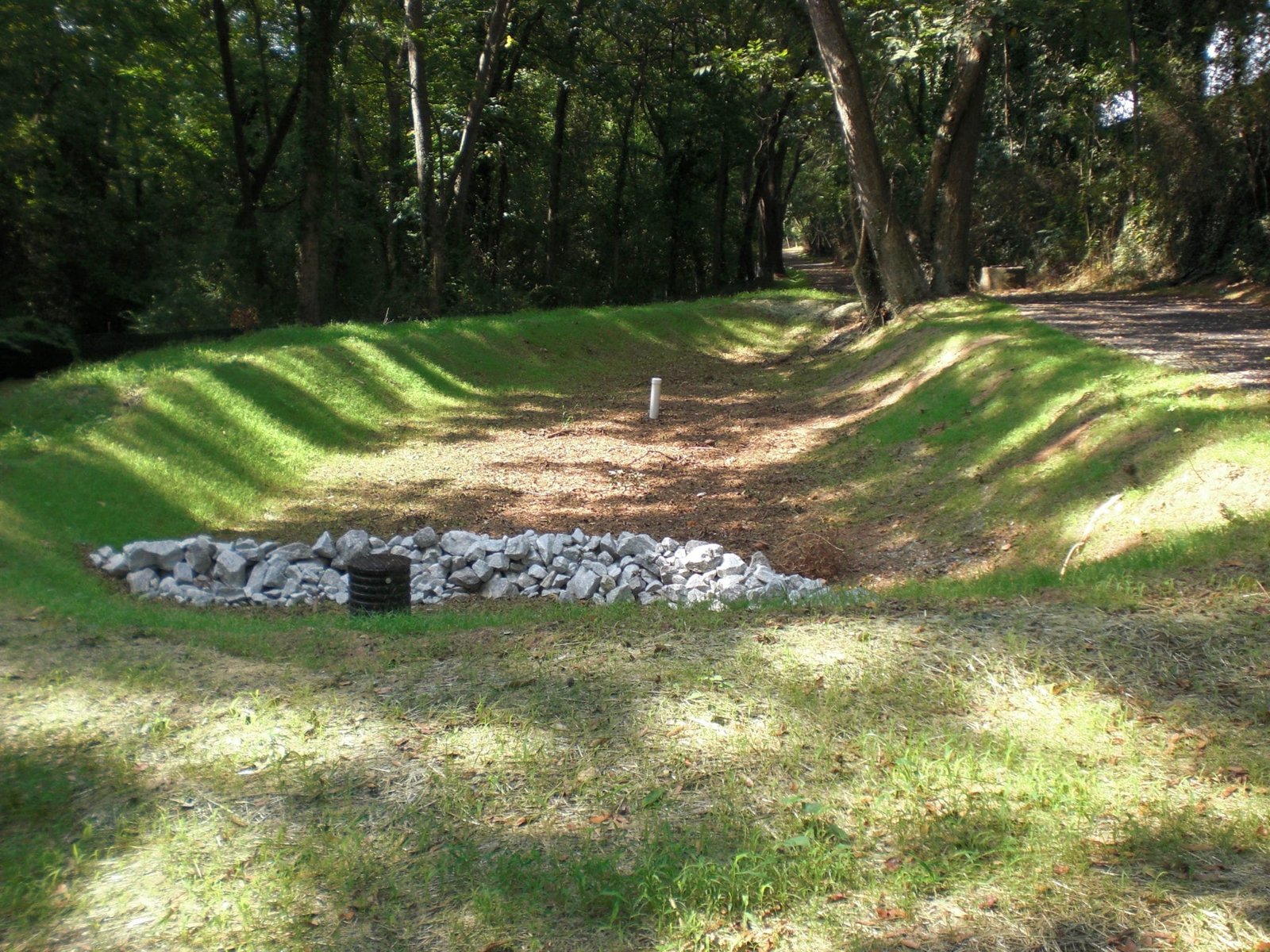
We build detention and retention basins, storm drain piping, inlets, culverts, swales, riprap channels and outfall structures for commercial, institutional and public owners. Some of that work is small and exacting, a trench drain at a loading dock or a roof-leader tie-in beside a historic wall. Some of it is large, such as a basin that must hold the runoff from a whole parking field before it is released at the rate the reviewers permit.
Because the land falls toward the Rio Grande from every direction, nearly every site we touch is part of some larger watershed. We try to build our piece so that it behaves politely toward the neighbor downhill.
Creeks, valleys and dams that tell the story
The region's water history is written into its places. Abiquiu Dam on the Rio Chama was completed in 1963 as a flood control structure, and its reservoir, with a full-storage capacity of 1,369,000 acre-feet, has never filled. Galisteo Creek winds through the Galisteo Basin, and Embudo Creek runs past Dixon before joining the Rio Grande about two miles downstream. These are reminders that water in this country is episodic and powerful.
Closer to the capital, the village of Agua Fria is bounded by NM 599 on the north and Siler Road on the east, and its low ground has long handled drainage from the surrounding slopes. When we work near the Agua Fria and Siler corridor or in a river-valley community such as Dixon, we begin by learning where the water already goes and then try to leave that path intact.
What a drainage package includes
A complete package begins with the grading plan and ends with the outfall. In between there are storm drain mains and laterals, curb inlets and area drains, headwalls, culverts under drives, grassed or rock-lined swales, and detention areas sized by the civil engineer. Many of these are installed alongside water, sewer and dry utilities, which is why we coordinate them with our site development and utilities work and with the earthwork described under mass grading.
We also build the pieces that keep a system working: sediment traps during construction, inlet protection, outlet energy dissipation and access for later cleaning. A basin that cannot be reached by a maintenance truck will not be maintained, so we pay attention to ramps, rims and fencing as closely as to pipe slope.
Reviews, permits and the paper behind the pipe
Drainage plans are reviewed before a grading or building permit is released, and the submission usually needs a stamped drainage report and a stormwater pollution prevention plan. Because exact submittal rules vary by jurisdiction and project size, we confirm them with the reviewer rather than rely on assumption. The state's commercial building code, the 2021 New Mexico Commercial Building Code, adopts the 2021 International Building Code as amended and took effect July 14, 2023, and drainage at the building edge is read against it.
Inside the historic districts there is an additional layer. Retaining walls, drainage structures and grading near older buildings can draw comment from the Historic Districts Review Board, which considers harmony of form, color, texture and material. A concrete headwall that would be unremarkable on an industrial site may need a stone facing or a different color to be accepted near the Plaza.
Fire, burn scars and the lessons of steep terrain
Some of the most instructive drainage conditions in the region come from fire. The Cerro Grande Fire began as a controlled burn on May 4, 2000, was declared extinguished on July 20, 2000, and was estimated by the US General Accounting Office to have caused $1 billion in damages. Anyone building near Los Alamos or on forested slopes learns that burned ground sheds water faster and carries more debris than unburned ground.
We carry that lesson into every steep site. We ask whether upstream slopes have been disturbed, size culverts conservatively when the contributing area is uncertain, and favor rock-lined channels over bare earth. If you are weighing a municipal or government building in an exposed location, tell us early so the drainage design and the structure can be developed together.
Letting the storm season set the order of work
Summer thunderstorms are the calendar that matters. We try to place pipe, inlets and outfalls before the wettest weeks so that a raw trench or unfinished slope is not sitting open when a storm arrives. Where that is not possible, we phase the work in short reaches, backfill each section promptly and keep pumps and temporary berms ready.
Drainage also sets the order for the trades that follow. Paving cannot be finished until inlets are at final grade, and landscaping cannot be planted until basins are shaped and stabilized. We tie these dates together on one schedule, so the paving crew, the parking lot subcontractor and the owner's landscape team are not guessing about each other.
Bring us the grading plan
If you have a civil set, a drainage report or only a rough sketch of the parcel, we will review where the water enters and leaves the property and tell you what we see. We also work with public sector owners who need drainage and paving built to a published procurement schedule.
Questions Owners Ask
Why do so many Santa Fe area sites need detention basins?
Developed ground sheds water faster than open land, and the storms here are short and intense. Reviewers commonly ask that the peak flow leaving a developed site be held to what the land produced before. A basin stores the surge and releases it slowly. We build them with stable side slopes, a lined spillway and a clear outlet so they do not become erosion problems of their own.
Can drainage be built in winter?
Pipe can be laid in cold weather if the trench stays unfrozen, the bedding is placed properly and backfill is compacted in lifts. Concrete structures need protection from freezing. We tend to schedule major basins and culverts in the warmer months and save lighter work for shoulder seasons, particularly where the summer storm season could follow too soon after an unfinished slope.
What happens if the construction site floods before the permanent system is done?
This is why temporary measures matter. We install perimeter controls, sediment traps and protected inlets before disturbing the ground, and we shape temporary grades so water leaves the site by a known route. After a storm we walk the site, clear debris and repair damage before the next one. A well-managed temporary system protects both the neighbors and the owner.
Does a historic district change how drainage is built?
It can. The visible parts, such as walls, headwalls, channel linings and grates, may be reviewed for material and color, and work near older buildings often calls for care around foundations that were never designed for modern runoff. We bring the drainage engineer and the architect into the same conversation so the solution is both functional and acceptable to the board.
Who maintains a detention basin after we finish?
Normally the owner or an owners association, under a maintenance agreement tied to the approval. We build for that reality by providing maintenance access, accessible outlet structures and as-built drawings, and we explain what needs to be inspected after storms and each spring.