
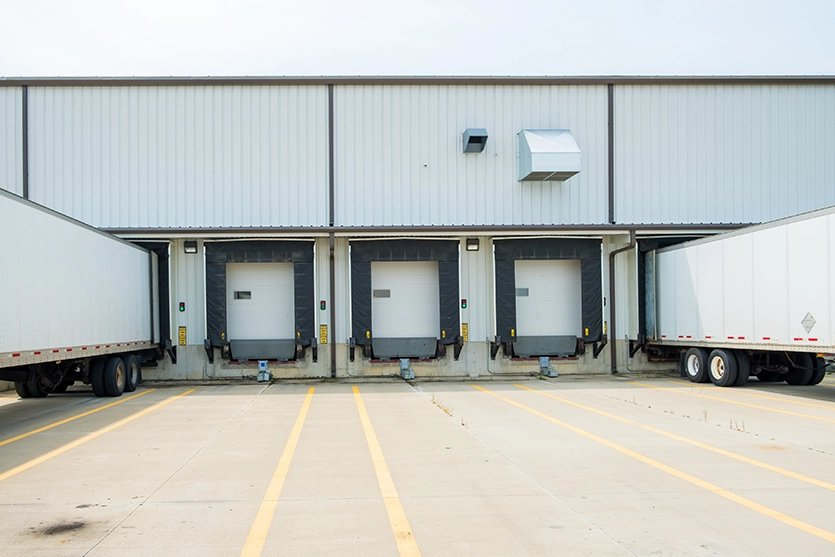
A trailer rarely sits still for long in a cross-dock, and the building around it has to be designed for the minutes between arrival and departure. A long, narrow structure with doors on both sides, a deep concrete apron and room for a rig to swing without backing into traffic is not complicated, but it is unforgiving of small mistakes. We build truck terminals and cross-dock buildings for carriers who care about how those minutes are spent.
Northern New Mexico is a corridor market. Freight moves along I-25, along US 84 and US 285, and along the secondary roads of the Rio Grande valley, and the places where carriers choose to break bulk are tied to those routes. US 84 and US 285 pass downtown Santa Fe on St. Francis Drive and merge with northbound I-25 at exit 282A, and farther north they continue as a limited-access freeway for part of their length toward Pojoaque and Espanola.
A terminal is also a neighbor. Engines idle, trucks arrive at night, and lights shine across the yard. We help carriers design for those realities, so the building works on its own terms and does not give a county commissioner reasons to hesitate.
Corridors where terminals are planned
At Pojoaque, the US 84/US 285 interchange near milepost 183 connects with NM 502, the main route to Los Alamos National Laboratory, and NM 503. That junction is a natural place for a carrier that serves the northern valleys and the laboratory. Los Alamos can be reached only by NM 4 and NM 502, so freight bound there often passes through Pojoaque on the way.
To the east, I-25 bypasses downtown Las Vegas, and Interstate 40 lies 55 miles to the south via U.S. Route 84, which makes the Las Vegas area useful for carriers that move between the northern towns and the east-west freight corridor. Closer to Santa Fe, the interchanges on NM 599 give direct access without crossing the city. We study each site against the turning paths of the trucks that will use it.
Site, approach and neighbors
The first question for a terminal parcel is how a rig enters and leaves it. A deep lot with a long driveway holds queues off the public road, and a wide, level court allows trailers to be spotted without conflict. We draw the truck movements on the site plan with the carrier's own vehicles in mind: tractors with 53 foot trailers, straight trucks, and perhaps doubles.
Drainage and surface are the next questions. A court that ponds water will freeze in winter and rut in summer, and a drainage system that sends oil to a creek will bring the wrong kind of attention. We design the court with slope, inlets, an oil and sediment separator where needed, and a stormwater plan that satisfies review. The stormwater and drainage trade crews build these systems alongside the paving.
The building and the yard
A cross-dock is usually a long, narrow building, often only about a hundred feet deep, with dock doors along one or both long sides. The structure is typically a tilt-wall building or a steel frame, with a slab designed for lift trucks and heavy axle loads. Dock levelers, bumpers, seals, lighting and sprinklers follow. A small office, a driver lounge and restrooms complete the building, and we usually add a maintenance bay or a small parts room if the carrier services its own equipment. Those extras change the sprinkler design, the floor drains and the ventilation, so we raise them in the first meeting.
The yard is as important as the building. Heavy concrete aprons at the docks resist the pounding of trailer landing gear, and asphalt or concrete paving elsewhere is designed for turning, braking and standing loads. Our truck courts and dock aprons work is carefully scheduled so that the concrete cures before trucks arrive. Parking for trailers and employees completes the picture, and parking lot construction is part of the same package.
Keeping drivers and dock workers safe
A terminal is one of the busiest places a person can work, with forklifts, trucks and pedestrians in close quarters. We plan the safety features at the drawing stage: separate lanes and gates, marked walkways, dock restraints, edge protection, adequate lighting and good sight lines. We also plan the construction site with similar discipline, since delivery trucks and heavy equipment share the same ground.
Spill control and fuel handling deserve attention too. If the terminal will fuel or wash vehicles, we design the pad, the drains and the containment to suit the operation and the review. A conversation with the fire marshal in advance saves time later, particularly where idling, battery charging or vehicle maintenance is planned.
Building while freight keeps moving
Many terminal owners already operate somewhere, and the new building has to open without a gap in service. We phase the work so that the site and the paving are completed ahead of the building, and we plan the move with the carrier's operations staff. Seasonal freight peaks are marked on the calendar so that we avoid them.
Permit and approval timing dominates the early schedule, and equipment orders dominate the later part. Dock levelers, overhead doors and electrical gear can have lead times of several months. We order them when the design is stable, and we track them through delivery. Owners in logistics and distribution often tell us the opening date is a commitment to customers, and we plan with that in mind.
Show us the route and the freight
Tell us where your trucks come from, where they go and how many a day you expect. We will draw the movements with you, study the parcel, and give you a candid view of what can be built there. If you want to compare with a storage-led building, read about warehouses first.
Questions Owners Ask
How deep should a cross-dock be?
The depth depends on what is moved. Narrow buildings favor a quick flow from door to door, while deeper buildings allow staging and sorting. We discuss your freight, the number of trailers and the labor model before we recommend a dimension.
What paving do truck courts require?
Heavy concrete at the dock aprons, and concrete or heavy-duty asphalt elsewhere, over a well compacted base designed for the traffic. Trailer landing gear and turning movements can destroy a light pavement quickly. We design to the loads you expect.
Can we put a terminal on a rural parcel?
Often, but utilities, access and neighbors need study. Rural parcels may lack water, sewer and three-phase power, and may sit on narrow roads. We examine these early and include any extension cost in the estimate.
Will the county ask about noise and lighting?
Frequently. We design lighting that is shielded and directed to the yard, and we place the docks and the entry to keep noise away from neighbors where we can. Presenting that plan at the first hearing often makes the process smoother.
Which codes govern the building?
The 2021 New Mexico Commercial Building Code, the energy code and the fire code, together with local zoning and drainage requirements. We confirm the current editions before we submit drawings.