
Sites along the Santa Fe Relief Route reward a contractor who can move dirt, bring utilities to a pad and finish a building without needing the historic core's patience. We build flex and light-industrial space, service and trade buildings, offices, medical clinics and small distribution buildings for owners who want highway access without the congestion of the city center, and we do the grading and site work that those parcels usually need.
NM 599, also called Veterans Memorial Highway, is 14.019 miles long, from an at-grade intersection with NM 14 (Cerrillos Road) to a trumpet interchange with US 84/US 285, and construction was completed in November 2000. It gives trucks and service vehicles a way around the city, and it has become the setting for the kind of work that does not belong beside the Plaza.
Interchanges and what they open up
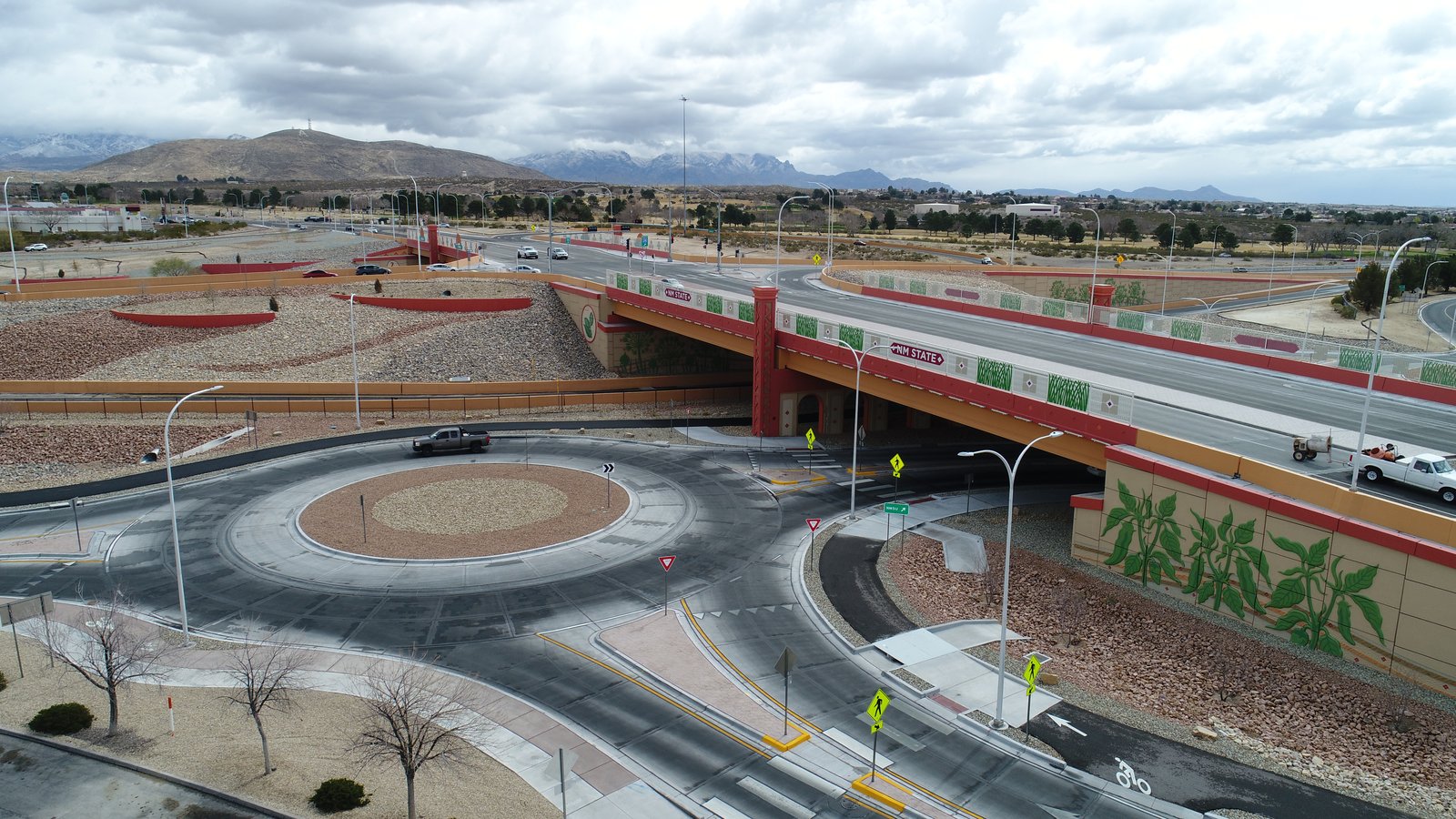
An interchange is a development tool, and NM 599 has several. It meets I-25 at a diamond interchange, I-25 exit 276, on the border of La Cienega, rebuilt from a partial cloverleaf in 2009. Its other interchanges include Jaguar Drive, which opened November 18, 2015, South Meadows Road (CR 62), a dumbbell interchange, Camino La Tierra and Ridgetop Road, and the Rail Runner's Santa Fe County/NM 599 station sits in the median of I-25 at the NM 599 interchange, opening August 1, 2009.
Each interchange sets a different kind of parcel in play. Those near I-25 suit service and logistics uses, while those that reach residential areas suit medical offices and neighborhood retail. We help owners match building type to access before they spend on design.
Dirt, concrete and steel under one team
The edge-of-town sites on NM 599 are mostly greenfield, and their first costs are in the ground. We handle mass grading, utilities, drainage and paving through our own supervision, and we schedule and inspect concrete foundations and slabs closely where the schedule gains. A slab placed under the same supervision as the pad below it behaves better, because the same team knows how well the subgrade was compacted.
On light-industrial and flex projects, we manage tilt-up or steel frame erection, metal panels and tenant bay finishes on a schedule driven by the shell. Tight control of the base lets owners lease bays in phases, with later phases finishing while the first tenants move in.
Moving trucks, crews and materials
Highway frontage speeds deliveries, and we use it. Crews reach sites quickly from I-25, concrete and aggregate trucks have a direct route and large equipment can arrive without passing through town. We still coordinate with the county and the New Mexico Department of Transportation when a driveway or intersection will be affected, and we arrange traffic control for the work, because access permits, rather than construction, are often the longest items.
The schedule also has to allow for site-specific conditions: testing of subgrade soils, utility connection dates, and inspections by county and state agencies. We list them with durations so owners can see how much of the calendar belongs to approvals.
Buildings we build along the route
The usual scope includes flex and light-industrial buildings, contractor yards with shops, medical and professional offices near the Meadows interchanges, auto-related and service buildings, and retail pads. Each has its own concerns: drive aisles and truck turning radii for yard buildings, floor flatness and clear height for light-industrial space, exhaust and loading for service buildings.
Owners who want a larger distribution or logistics facility should read about logistics and distribution projects, where dock apron concrete, trailer parking and fire access dominate the plan. We also build truck courts and dock aprons that carry heavy axle loads without rutting.
Nearby places we cover from this corridor
The route links several parts of the metro. From the same crews and equipment yards, we reach the Santa Fe Regional Airport business park, the Agua Fria and Siler Road corridor and the southern edge of the city. Airport Road (CR 56) meets NM 599 at an at-grade intersection and provides access to the Santa Fe Regional Airport, so that area is a short trip for materials and crews.
That proximity lets us offer owners a coordinated plan for more than one parcel. If you hold land at several interchanges, we can sequence site work so equipment and crews move from one to the next.
Codes and approvals for edge-of-town sites
New buildings follow the 2021 New Mexico Commercial Building Code, which adopts the 2021 International Building Code as amended and took effect July 14, 2023, and the 2021 New Mexico Commercial Energy Conservation Code, effective January 30, 2024. Energy provisions affect envelope, lighting and mechanical choices in a flex or office building, so we ask the design team to confirm the compliance path before bids and not afterward.
Outside city limits, site approvals can involve the county as well as state agencies, and utility service may depend on extensions that take time to approve. Fire access, water supply for suppression and drainage are the items that most often shape a layout. We place them on the preconstruction checklist and keep the owner informed as each one clears.
Put a pad on the relief route
Send the parcel and the building you have in mind. We will price the grading, utilities and shell, check the access approvals and outline a phased schedule.
Questions Owners Ask
Which NM 599 interchanges are best for commercial development?
It depends on the use. The I-25 interchange at exit 276 offers direct interstate access, Jaguar Drive opened in 2015 and serves newer areas, and South Meadows Road is a dumbbell interchange that reaches residential neighborhoods. Airport Road meets the route at an at-grade intersection. We do not pick a site for an owner, but we can compare access, utilities and grading for each parcel.
What does it take to build a flex building on a raw pad?
Site work comes first: clearing, mass grading, drainage, utilities and a compacted base. Then foundations, slab and frame, followed by envelope and bay finishes. We usually build the shell first and finish bays as tenants sign, so cash flow matches leasing.
Who approves a driveway onto a state route?
Access to state routes involves state transportation review, and county or city approvals may apply as well. We identify the responsible agencies at the start of preconstruction and allow time for traffic studies, permits and design changes, since access is frequently the longest approval.
Can you build in phases as tenants sign?
Yes. We design site infrastructure for the full build and construct shells or first buildings in phases, with later bays finished on demand. This lowers the up-front cost and shortens the time to first rent, and it lets the owner learn from the first building what the next one should change.
Do you build near the Rail Runner station?
The Santa Fe County/NM 599 station sits in the median of I-25 at the NM 599 interchange and opened August 1, 2009. We would plan access, parking and pedestrian routes with the county and the transit agency, and we would take care with noise and vibration near the right of way.