
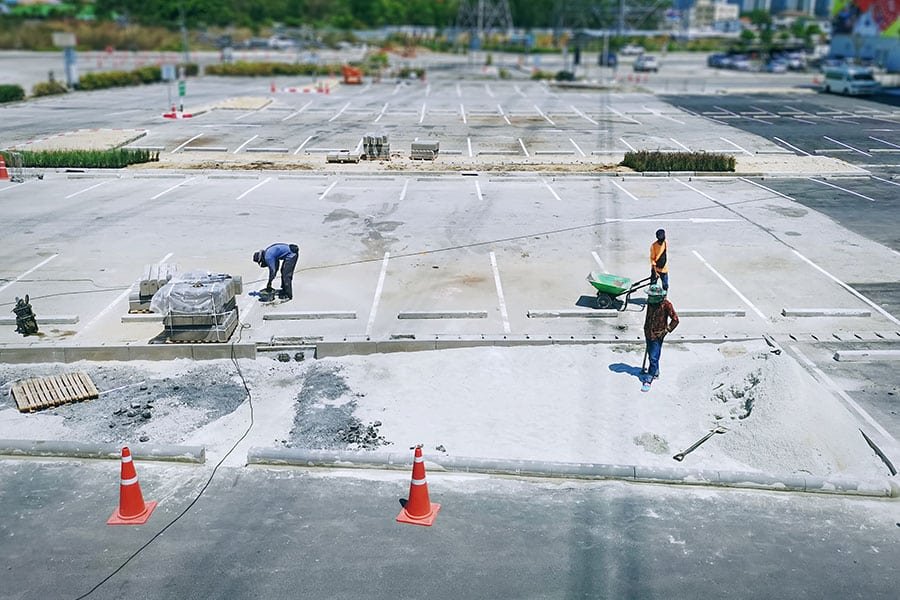
Parking Lot Construction Around Santa Fe Destinations and Campuses
Between 2022 and 2024, Santa Fe Regional Airport completed a terminal expansion and new parking lots, a quiet reminder that a parking field is a major public investment and not a leftover piece of ground. Cars arrive in waves, snow comes off the roof and pools at the low corner, and people with luggage, strollers and mobility aids all need to cross the same pavement. A lot that works well hardly seems designed. A lot that fails is hard to forget.
We build asphalt and concrete parking lots, drive aisles, curbs, sidewalks, accessible routes, striping, signage and lighting foundations for commercial, institutional and public owners. We also repair and resurface existing lots, which in this climate is a regular chore. Each lot has to take the weight of the traffic, drain water in the right direction and meet the rules that govern accessibility, fire access and, in the historic districts, appearance.
Our work begins with the base, because that is where most failures start.
From the subgrade up to the paint
The sequence is simple to describe and exacting to execute. We prepare the subgrade, install utilities and drainage structures, place and compact aggregate base, and then pave with asphalt or concrete. Curbs, gutters and accessible ramps follow or accompany the paving. Striping, wheel stops, signs, bollards and light pole bases complete the lot. Where delivery vehicles share the pavement with customers, the heavier lanes are built to the standards we use for truck courts and dock aprons, with thicker sections where the wheels turn.
Details separate good lots from adequate ones. Accessible stalls are laid out with cross slopes within the limits of the standard, aisles are sized for the turning radius of the vehicles expected, and landscape islands are drained so that irrigation does not wash onto the pavement. Where the lot sits beside a building, we coordinate with the slab and flatwork crew so that thresholds, walks and entries meet cleanly.
Rules for access, lighting and the historic edge
Parking lots meet a stack of requirements: zoning for the number of stalls, accessibility rules for stall counts and routes, fire department access for aisles and turnarounds, and stormwater rules for runoff. The state's commercial energy code, the 2021 New Mexico Commercial Energy Conservation Code, took effect January 30, 2024, and exterior lighting is one of the places an owner may see its effect.
Inside or beside Santa Fe's historic districts, the 1957 ordinance requiring Spanish Territorial or Pueblo style reaches farther than buildings alone. Walls, light fixtures, screening and surface treatments can be part of what the Historic Districts Review Board looks at. We bring samples, photographs and calm explanations to the board, and show how a lot's edges soften with planting and low walls. Drainage from the lot connects to the stormwater and drainage package.
Base thickness, compaction and the first winter
The first winter tells you whether a lot was built well. We compact the subgrade and base to the density the engineer calls for, test it and correct soft areas before paving. For asphalt, we monitor mix temperature and placement conditions, because hot mix laid on a cold base cools too quickly to compact, and we avoid paving late in the season unless conditions allow.
Joints and edges receive special care. Longitudinal joints in asphalt are common starting points for raveling, and concrete lots need correctly spaced saw cuts and sealed joints. Snowplow blades, de-icing chemicals and freeze-thaw cycles attack the weakest spots first, so we try to leave none. We also keep a short list of the places that fail first, such as turning areas, entrances and the low corner where meltwater collects, and we inspect those before the crew leaves the site.
Why a lot costs what it costs
The largest items are often the least visible: the amount of excavation and base, the drainage structures, the retaining walls on a sloped site and the number of curb returns and ramps. Surface choice is a smaller piece than owners expect. A large enclosed retail property such as Santa Fe Place, with roughly 3,261 parking spaces at 4250 Cerrillos Road, shows how quickly pavement area adds up, and how maintenance cost scales with it. The same arithmetic applies along the Cerrillos Road and St. Francis corridor, where every extra row of stalls has to be paved, drained, lit and kept clear of snow for as long as the property stands.
We help owners compare initial cost and life cycle cost. A thicker base or better drainage may add a modest amount now and save a rebuild later. Owners of lodging and restaurant properties, the audience for our hospitality group work, often value a lot that can be repaired in sections without closing the whole property.
Paving between seasons and around openings
Paving is one of the last major trades, so it often absorbs the delays of everything before it. We try to protect the paving window by finishing utilities and drainage early and by agreeing with the owner what will happen if an opening date arrives with the weather unsuitable. In many cases a temporary surface and a later final lift is the sensible answer.
Transit changes how lots are used. The Rail Runner Express serves four Santa Fe stations, and nearby owners think about walking routes, passenger drop-off and shared parking alongside spaces for cars. The same attention matters at the airport business park and in the corridors where retail centers compete for convenient parking.
Send us the site plan
If you are planning a new lot or restoring an old one, send us the site plan and the stall count and we will talk through base, drainage, lighting and accessible routes. We will also say plainly which parts of the budget are worth protecting.
Questions Owners Ask
How long should a new parking lot last in this climate?
A well-built lot can serve for many years, but freeze-thaw cycles and snowplows shorten the life of a poor one. Good drainage, a properly compacted base and prompt crack sealing do more than any single choice of surface. We recommend an inspection routine and a schedule for sealing and restriping so small problems stay small.
Is concrete or asphalt better for a parking lot?
Each has its place. Asphalt is quicker to place and easier to patch, while concrete lasts longer in heavy-use areas and does not rut. Many owners use concrete at entrances and trash enclosures and asphalt for the rest. We price both for your site and compare lifetime costs.
Can a lot be built near the historic districts?
Yes, with attention to appearance. The Historic Districts Review Board considers harmony of style, form, color, height, proportion, texture and material, and a lot's walls, fixtures and screening can fall within that review. Early drawings and samples help.
What does a resurfacing project involve?
We test the existing pavement, repair failed areas, mill if necessary and place a new surface course, then restripe. If the base has failed, overlaying it simply hides the problem for a short time, so we recommend a deeper repair where needed.
How do you handle snow storage?
We designate areas for plowed snow on the plan, away from drains, accessible routes and fire lanes, and slope them so meltwater drains properly. A lot without a snow storage plan is a lot that floods at the first thaw.