
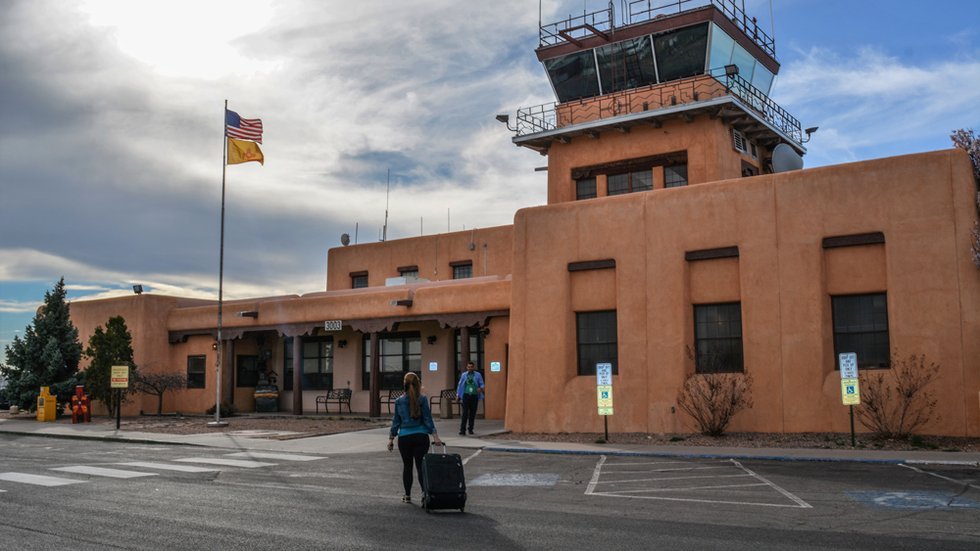
General Contractor at the Santa Fe Regional Airport Business Park
Airport-adjacent land asks a builder to think about aircraft, fire apparatus and height limits alongside the usual structure and finish. We build hangars, aviation service buildings, flex space and offices on and around Santa Fe Regional Airport, and we coordinate the work with the airport owner, the operators on the field and the agencies whose approvals apply. We do not guess at airside rules; we ask, and we write the answers into the schedule.
Santa Fe Regional Airport (IATA SAF) covers 2,128 acres, with scheduled airline service. It is city-owned and about 10 miles southwest of the center of Santa Fe, and it has two fixed base operators, Jet Center at Santa Fe and Signature Flight Support. That mix of scheduled service and general aviation shapes the buildings that owners want here.
Hangars and the buildings around them
Aircraft storage is the signature building type. A hangar is a clear-span volume with a large door, a floor that carries aircraft loads and drains safely, and fire protection suited to fuel and aircraft. We build aircraft hangars in steel or metal-building systems, with insulated panels, bi-fold or hydraulic doors and slabs sloped for drainage, and we coordinate foundations with the geotechnical engineer.
Around the hangars come offices, shops, parts storage and fuel facilities, which have their own rules for separation and spill control. Pre-engineered metal buildings are a good fit for much of this work, since they provide wide clear spans at a reasonable cost and allow phased expansion.
Land leases, approvals and codes
Much airport land is leased, not owned. An April 16, 2025 City of Santa Fe memo proposed leasing 1.57 acres of undeveloped airport land to Jet Center at Santa Fe Real Estate, LLC to build an aircraft storage hangar, with a 40-year initial term, two 5-year options and first-year rent of $12,993.91. We cite that proposal only as an example of how this land is offered, and owners should expect lease approval, design review and building permits to proceed on their own tracks.
Construction follows the 2021 New Mexico Commercial Building Code, effective July 14, 2023, with the 2021 International Building Code as the base. We confirm height, lighting and construction notification requirements with the airport and the relevant agencies before design is finished, and we list each approval with its duration.
Operators, owners and agencies
The field supports a range of users: fixed base operators serving visiting aircraft, private owners who need hangars, a New Mexico Army National Guard aviation support facility operating UH-60 Black Hawk helicopters, and businesses that value airport proximity. Public owners require formal bidding and documentation, which we handle under our government and public sector practice.
Private operators tend to focus on speed, on the ability to expand and on a clear picture of what a hangar bay will cost per square foot of door opening. We talk through phasing: a first hangar built now, with a second bay or office added when demand returns, and utilities and site work sized for it. Logistics and distribution users interested in air cargo or time-sensitive shipping should speak to us about truck access and docks.
Working near aircraft and operations
The first conversation with an airport project is about operations, not design. Where are aircraft taxiing, which areas are restricted, how are workers badged and escorted, and when are the busiest periods? We prepare a safety and phasing plan, in the same spirit as our phased construction on occupied sites, that answers these questions, submit it for approval and brief every worker before they enter the area.
Cranes and tall equipment need special attention, since temporary heights near an airfield can be as restrictive as permanent ones. We coordinate crane use in advance, mark equipment as required and avoid lifts during sensitive times. Foreign object debris is a real issue, so we keep the site swept and the loads covered.
Access, utilities and the land itself
Airport Road (CR 56, formerly NM 284) meets NM 599 at an at-grade intersection and provides access to the Santa Fe Regional Airport. Trucks arriving from the interstate use it, and we plan delivery routes accordingly, with traffic control at the intersection when large loads arrive. Many parcels need utility extensions, and fire water, sewer and power capacity determine how much can be built.
The ground is a further variable. We recommend borings and a geotechnical report for every airfield parcel, and we review drainage with the engineer, because water that leaves a hangar apron must have somewhere to go. Our nearby page on the NM 599 relief route describes the highway interchanges that connect the area to the rest of the metro.
Safety on an active airfield
Every worker on an airport site receives instruction on movement areas, vehicle rules, radio use where required, and the danger of jet blast and propeller wash. We keep pedestrian paths marked, vehicle speeds low and escorts available, and we stop work if operations require it. A site safety officer reviews activity daily with the airport contact.
Hot work, fueling and storage of materials follow the airport's fire safety rules, and we keep extinguishers and spill kits where they are needed. We plan for operational interruptions, and our schedules allow for them so that safety is never traded for progress. When an airline schedule, a medical flight or a military training period requires the area to be quiet, we stop and resequence the work.
Build near the runway with a plan
Tell us the lease status, the aircraft you plan to store and the services you need beside them. We will outline approvals, price the structure and schedule the work around the field.
Questions Owners Ask
How long does it take to lease and build a hangar?
Lease approval, design review, permitting and construction each take their own time, and they do not always run in parallel. A City of Santa Fe memo from April 2025 proposed a 40-year initial lease term for 1.57 acres of airport land for an aircraft storage hangar, which shows the scale of commitment. We prepare a schedule that lists each approval and the steps that depend on it.
Can I build a hangar with a metal building system?
Yes, and many owners do. Pre-engineered systems offer wide clear spans, insulated panels and doors sized to aircraft, with a foundation designed for the soils. Fire protection, drainage and door selection need careful engineering, and we coordinate them with the design team.
What restrictions apply to cranes and tall equipment?
Heights near an airfield may be limited, and temporary equipment can count. We confirm the limits with the airport and the relevant agencies, schedule lifts around operations and mark equipment as required. These conversations belong in preconstruction, not on the day of the lift.
Which fixed base operators are on the field?
Santa Fe Regional Airport has two: Jet Center at Santa Fe and Signature Flight Support. Owners who plan to sublease or serve visiting aircraft should speak to the airport and the operators early about services, fuel and ground handling, and we can then plan the building around the conversation.