
Mass Grading for Santa Fe and Northern New Mexico Sites
Ground in the Santa Fe region carries more history than most owners expect when they buy a parcel. The Pueblo Alamo archaeological site lies near the junction of I-25 and US 285 in the Eldorado area, and the Galisteo Basin holds abandoned Tanoan villages, so the first question we ask about a future building pad is what the earth has already been used for. Mass grading here begins with records and conversation, and only afterward with machines.
We cut, fill and shape large pads, truck courts, retention areas and access roads for commercial, institutional and light-industrial owners across the metro. Some of that work sits on the flat, open parcels near the bypass, and some of it climbs onto sloped, rocky ground where every bench has to be cut with care. In both cases the earthwork is the part of the project that cannot be quietly corrected later, so we give it time at the start.
That patience is a practical choice. A pad that has been compacted in sound lifts, drained properly and cleared by the right people will carry a building for a very long time, and it keeps the reviewers who come after us comfortable. We would rather hand a foundation crew a quiet, stable site than a fast one.
Reading the land south and west of the capital
Much of the earthwork we are asked to price lies on the southern edge of Santa Fe, where the Community College District plan covers about 17,000 acres and became part of the county's Sustainable Land Development Code in 2016. That plan decides where roads, village centers and open land fall, so a grading scope there has to respect a pattern drawn before the owner arrived. Our work in the Community College District and the neighboring Rancho Viejo villages starts with that plan laid beside the owner's survey.
Farther out the question changes. Eldorado at Santa Fe sits at 6,683 feet and close to a known archaeological site, while the Galisteo Basin has its own soils, its own creek and its own record of settlement. Different parcels mean different haul distances, different approvals and different expectations from neighbors, and we do not treat one site as a model for the next.
What we ask before the first cut
We begin with the questions an earthwork contractor is rarely thanked for asking. Has an archaeological review been requested for this parcel, and by whom? Is there a geotechnical report, and does it describe the soils at the depth we will be cutting? Where will topsoil go, where will surplus material go, and who owns the haul road on the day the trucks arrive? Answers to these shape the price more than the yardage does.
We also walk the boundary with the owner. Natural drainage lines, old fence rows, abandoned two-track roads and rock outcrops tell us things a survey drawing leaves out. We note where a neighbor's wall sits close to the grading limit, where dust will travel on a windy afternoon, and where the finished grade needs to meet an existing road. A short walk of this kind has saved us longer conversations later.
Stripping, benching and compaction in the order the soil allows
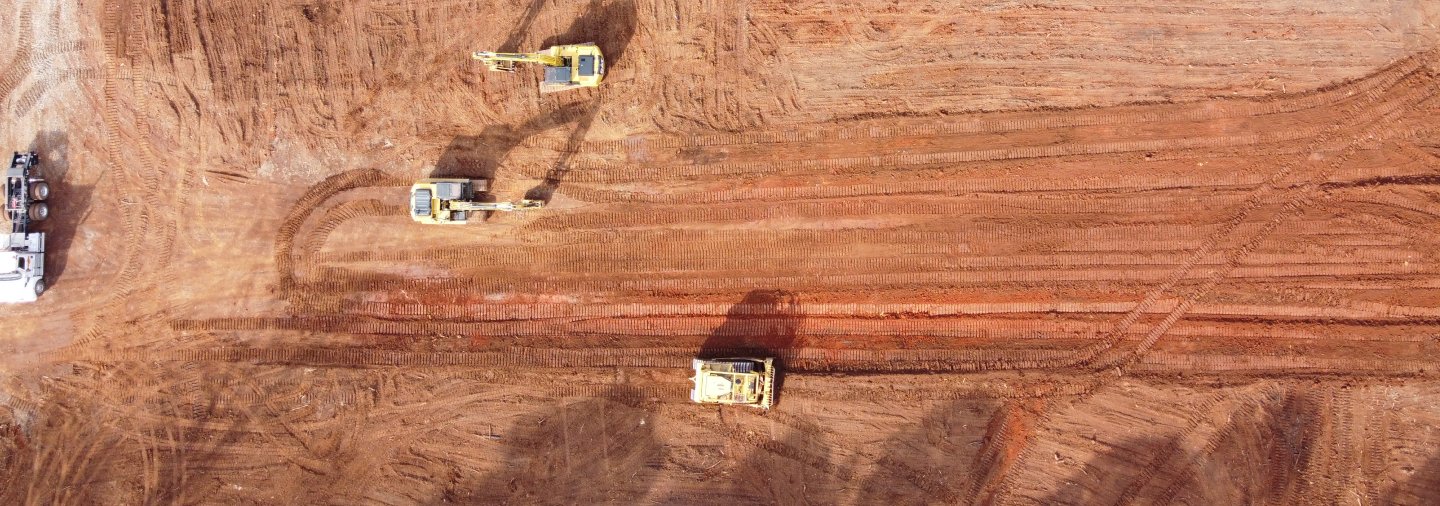
Topsoil is stripped first and stockpiled where it can be recovered for landscaping. The exposed subgrade is then proof-rolled so soft pockets show themselves before fill is placed on top of them. On slopes we cut benches into the existing ground so new fill ties into native material instead of sliding on it, and fill is placed in controlled lifts at the moisture the geotechnical engineer specifies.
In dry country, moisture conditioning is real work. Water trucks run steadily, compaction equipment follows, and an independent laboratory tests the lifts as they go. Where the plans call for a building pad that will later receive concrete foundations, we hold the final trim until the footing layout is confirmed, because a pad cut perfectly and then re-cut for a foundation change has been graded twice.
A calendar that leaves room for review
Clearance comes first on the schedule, even when it is not yet under our control. We sequence the earthwork so that mobilization waits for written confirmation, and we use the quiet interval to order erosion control, lay out haul routes and coordinate with the utility crews described in our site development and utilities work. The review of a historic or public project can move at its own pace, and a good schedule absorbs.
Winter matters at this elevation. Frozen ground cannot be compacted to specification, and fill placed on a frozen layer settles when it thaws. We plan the heavy fill for the warmer months, keep cuts and haul-road work for the shoulder seasons, and tell owners plainly when a late start will push critical placement into the following spring.
Where earthwork cost really sits
Yardage is the first number owners look at and the least reliable. The larger drivers are the balance between cut and fill, the distance to a disposal or import source, whether rock is encountered, the water needed for dust control and compaction, and any monitoring required by the reviewing agency. A site that balances on its own is a very different bid from one that must import material across the county.
For a commercial developer assembling a flex or warehouse parcel, we often price the earthwork in two layers, a base scope and a list of clearly described alternates. That lets the owner see how much of the cost belongs to the land and how much to the building, which matters when a flex light-industrial program is still being tested against a budget.
Walk the parcel with us
Send us the survey, any soils report you have and the building program, and we will walk the parcel with you before a price is discussed. If permitting is still ahead of you, our permitting and entitlements experience can help sort out what needs to be settled first.
Questions Owners Ask
Do I need an archaeological review before grading a parcel near Eldorado?
Parcels near known sites should be checked before any soil is moved. The Pueblo Alamo site lies near the I-25 and US 285 junction, and the Galisteo Basin holds many others. We ask the owner, the design team and the relevant state agencies what clearance applies, and we do not mobilize equipment until the answer is written down. Handling it early costs weeks. Discovering a problem mid-cut can cost a season.
How long does a typical building pad take to grade?
It depends on the volume, the balance between cut and fill and the weather. A modest pad on a gentle slope may take a few weeks of active work, while a multi-acre site with benching and import can run through a season. Testing and approvals add time that machines cannot shorten. We give owners a range after seeing the survey and soils information, and we update it whenever the ground teaches us something new.
Can earthwork continue through a northern New Mexico winter?
Cutting and hauling can often continue in mild stretches, but structural fill cannot be placed on frozen ground or compacted when it is frozen. At 6,000 feet and above, overnight temperatures can undo a day of good work. We schedule critical fill for warmer months and use winter for the work that tolerates cold, such as clearing, rough haul roads and some drainage trenching.
What changes if the geotechnical report finds expansive or soft soil?
It changes the cut depth, the compaction method and sometimes the building pad design. We may over-excavate and replace unsuitable material, add a layer of engineered fill or recommend a different foundation approach. The engineer decides what is needed, and we price the remedy openly so the owner can weigh it against the alternatives.