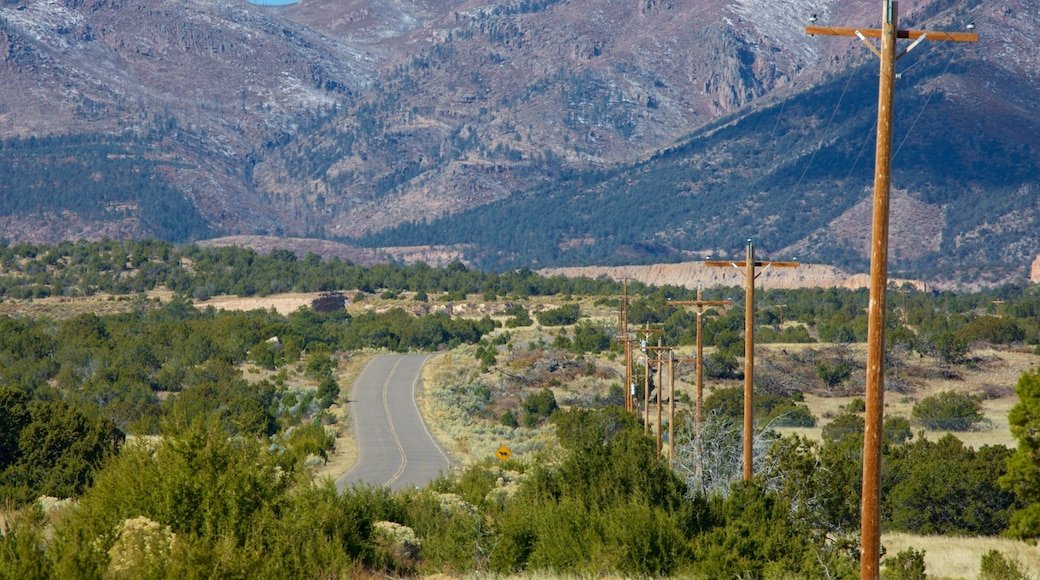
A building in Espanola has to be laid out with water in mind before it is laid out with rooms in mind. The town sits where the Rio Grande, the Rio Chama and the Rio Santa Cruz meet, at an elevation of 5,591 feet, and that setting shapes drainage, soil investigation, utility routing and the timing of excavation. We build commercial, institutional and civic projects for owners who want a general contractor that reads the site first.
The location is also practical. NM 68 begins here concurrent with US 84 and US 285, and it is a four-lane divided road with a 60 mph limit between Espanola and Velarde, which makes the town a reasonable base for deliveries that continue north toward Taos or up toward the mesa at Los Alamos. We treat that role seriously: a project in Espanola often has suppliers, crews and tenants arriving from three directions, and the schedule should account for each.
What drives building in the valley
Employment shapes what gets built. Los Alamos National Laboratory is the largest employer of Espanola residents, at over 12% of employment, with education second, and Akal Securities Inc. employs over 500 people locally. Those numbers describe a workforce that commutes, that needs convenient shopping, services and clinics, and that supports schools and public buildings. They also describe an owner base that is cautious with capital and appreciates a builder who explains costs plainly.
We see demand for retail pads, medical and professional offices, school improvements, housing for local workers and civic buildings. Our related pages on Los Alamos and Taos describe the neighboring markets, and many owners in the valley work in both, so we keep our cost and logistics assumptions consistent across them.
Work we manage directly
Where a project is modest in scale or the schedule is tight, we prefer to keep trades under our own supervision. In Espanola that usually means site concrete, footings and slabs, rough carpentry, framing and general finish work, along with the layout and coordination that connects the other trades to them. Managing that work directly gives the owner a single point of responsibility and, in a smaller market, helps us control the schedule when specialty subcontractors are busy elsewhere.
It also helps with quality. When we supervise how a slab is placed and finished, we know what the next trade will need from it, and we can correct a tolerance problem before it hides behind drywall. Our concrete foundations team works this way, and it is the first to learn from an excavation what the soil is actually doing.
Projects we build in and around town
The most frequent assignments are retail and restaurant buildings, medical and professional offices, school additions, public works and municipal buildings, and tenant improvements in existing centers. Public projects require a bid process and documentation that we know well, and our municipal and government building work follows the owner's forms from first submittal to closeout.
Site work is a major part of many Espanola jobs, since the building is only as good as the pad beneath it. Our site development and utilities scope covers clearing, grading, drainage, water and sewer connections, and paving, and we coordinate it with the structural work so the foundation sees stable, well-compacted soil on the day it is poured.
Owners and institutions
Education is the second-largest source of employment among residents, and school districts, colleges and training programs need classroom additions, renovations and maintenance work scheduled around the academic year. For these owners, education institution projects mean summer mobilization and tight turnover dates, and we plan accordingly.
Health care follows, with clinics and specialty practices serving residents who might otherwise drive long distances. Health care systems bring infection control, mechanical performance and certification steps that determine how the project is phased, and we plan to meet them. Smaller private owners value the same discipline, even when the scope is not formal.
What moves the price in Espanola
The largest swings come from the ground and the water. Soil conditions near the river valleys can require over-excavation, engineered fill or deeper footings, and a high water table or drainage requirement can change the sequence entirely. We encourage owners to commission a geotechnical report early and to share it with us before bids, since it removes a major unknown from the number.
The second driver is distance. A project 30 or 40 miles from a larger supply market carries haul time for materials and crews, but Espanola's position on a four-lane highway keeps that penalty moderate. The 2021 New Mexico Commercial Building Code, effective July 14, 2023, replaced the 2015 code, and we confirm with the design team that the drawings reflect the amended requirements, because a late code correction is the most avoidable cost on any job.
Beyond the town limits
For projects around Espanola, we plan mobilization along the valley to limit time lost to travel. We build in Pojoaque to the south, along the route that links the valley to Santa Fe, and in Chimayo and Ohkay Owingeh to the north and west, where approvals can involve additional authorities whose steps we respect and put on the schedule.
Owners on sovereign or community land should tell us early which entity approves the work, which inspections apply and who holds the utilities. Those answers decide the order of work more than any drawing does, and we would rather ask than assume.
Talk to us about your Espanola site
Share the parcel, the building program and what you know about the soils. We will study drainage, access and schedule, and respond with a plan and a price you can compare with confidence.
Questions Owners Ask
Do the rivers make Espanola a difficult place to build?
They make it a place that needs careful site investigation. The Rio Grande, the Rio Chama and the Rio Santa Cruz meet here, so drainage, floodplain questions and soil conditions deserve attention before design is final. We recommend a geotechnical report and a drainage study during preconstruction, and we adjust the foundation and grading plan to what they show.
Can you serve projects in Taos and Los Alamos from Espanola?
Yes. NM 68 begins in Espanola as a four-lane divided road with a 60 mph limit as far as Velarde, and it continues north to Taos, while NM 502 connects to the mesa at Los Alamos. We plan crews and deliveries to take advantage of that geography, though two-lane stretches north of Velarde require more schedule allowance.
What kinds of public projects do you bid in the area?
We look at municipal buildings, school improvements, community facilities and utility-related structures. Public work comes with formal bidding, prevailing procurement rules and closeout documentation, and we prepare for those requirements in advance. We also help owners understand how alternates and phasing can bring a project within a fixed appropriation.
How should I plan a school or public project around the calendar?
Start with the date the building must be ready and work backward. Public bids, submittals, long-lead equipment and inspections each take their own time, and summer is the usual window for work that cannot happen while students are present. We build a schedule that shows those dependencies so the owner can decide early whether to phase the work or adjust the opening date.
Which building code applies to a new commercial project?
The New Mexico Commercial Building Code adopts the 2021 International Building Code as amended, effective July 14, 2023, and replaced the 2015 code. Energy, electrical, plumbing and mechanical codes have their own editions and dates. We confirm each against your permit date before submittal.