
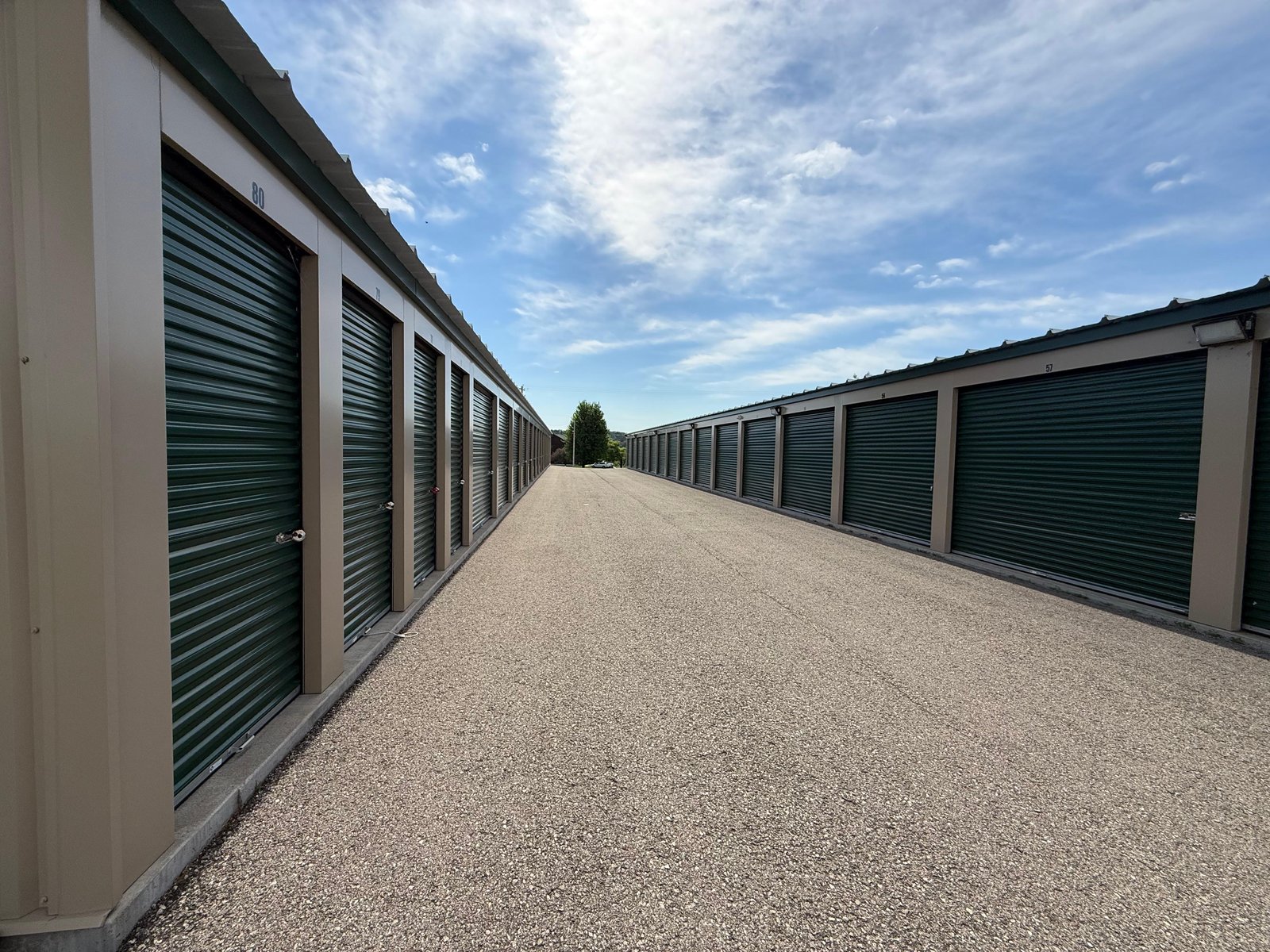
Self-Storage Construction in Santa Fe and Northern NM
Where homes arrive faster than garages, storage follows. Rancho Viejo, south of Santa Fe, had about 1,400 houses built as of a June 2023 report, with a projected 8,000 to 10,000 homes over the next 50 years, and Eldorado at Santa Fe holds 6,005 residents across 20.78 square miles. Growing neighborhoods of compact lots and smaller homes create steady demand for places to put furniture, tools, seasonal equipment and inventory. We build self-storage facilities for owners who want to meet that demand with a well-sited, well-built property.
A good self-storage property is simple in plan and exacting in execution. Rows of drive-up units, climate-controlled interior corridors, a leasing office with a secure entry, fenced yards for vehicles and a layout that lets trucks turn all rely on a few repeating components. The savings come from repeating them well. Owners rarely win by designing something unusual, and they lose when slabs, doors or drainage are done badly across hundreds of units.
We have an unfussy approach. We help owners test a site, talk through the building mix, prepare a budget and manage the schedule so that the first customers can move in as soon as the certificate of occupancy is issued.
Drive-up, interior and multi-story facilities
Single-story drive-up buildings are the least expensive and the quickest. They use pre-engineered frames or light steel framing, concrete slabs, overhead doors and simple roofing. Interior climate-controlled buildings add insulation, mechanical systems, corridors and elevators in multi-story versions, and they command higher rents. A site often combines both, with a climate-controlled building near the entrance and drive-up rows behind.
Ancillary elements matter as well. Gate systems, cameras, lighting, a leasing office, truck rental areas, trash enclosures and landscaping all affect the opening and the operating costs. We coordinate these with the owner's operator, who usually has a preferred management software and security package. For self-storage facilities that use metal framing, our pre-engineered metal building experience speeds the shell.
Siting, access and the pull of the corridor
Storage is a convenience business, and convenience is measured in minutes. The properties that do best sit on corridors that residents drive daily. US 285 runs through the 285 Corridor between Eldorado and Lamy, and NM 599 meets I-25 at exit 276, giving owners places to consider along each route. Visibility from the road, a wide entrance for trucks and a layout that makes the office obvious on arrival are worth more than a clever building shape.
We pay attention to the less visible parts of the site: the width of drive aisles, the turning radius for moving trucks, the drainage that keeps water from entering units, and the lighting that makes customers feel safe at night. Utilities on the edge of town can be a major cost, so we look at the distance to water, sewer and power before the owner commits to a parcel.
Review, fire access and the neighbors
Self-storage in northern New Mexico is built under the 2021 New Mexico Commercial Building Code, with the 2021 Commercial Energy Conservation Code applying to conditioned spaces. Fire department access, hydrant coverage, sprinklers in multi-story buildings and lighting are reviewed carefully. Some sites also require landscape and drainage plans that address runoff.
Neighbors often have opinions about storage. Taller buildings, lights at night and truck traffic raise concerns, and a land use hearing may be part of the process. We prepare renderings and a plain explanation of hours, screening and traffic, and encourage the owner to meet nearby residents before the hearing. Where a site lies near recorded archaeology, such as the Pueblo Alamo site near the junction of I-25 and US 285 in the Eldorado area, we ask about clearance at the start of due diligence.
Where the money goes
Site work often costs more than owners expect: mass grading, retaining walls, drainage, utilities and paving can approach the cost of the buildings. We recommend paying close attention to site development and utilities in the feasibility stage. After that, slabs, building frames, overhead doors and roofing make up most of the remainder.
Climate-controlled and multi-story buildings cost much more per square foot than drive-up rows, but rent for more. We model both on the same site so the owner can see the tradeoff. We also advise on phasing: building the first portion, opening, and adding more as demand proves out can reduce the financial exposure.
Grading deserves a word of its own. Hillside parcels around Santa Fe often need cuts and fills, retaining walls and drainage swales to produce level building pads, and the earthwork sequence, which we describe under mass grading, decides how much material is hauled on or off the site. We walk the site with the owner and ask the surveyor to confirm quantities, since unbalanced earthwork is among the quiet reasons a storage budget grows. Rock excavation, where it occurs, is priced as a separate item so that it does not hide inside a lump sum.
Where we build storage
We build across Santa Fe County and the northern towns. Edges of the city, such as the NM 599 interchanges and the neighborhoods around Rancho Viejo and Eldorado, attract owners who see housing growth, while towns such as Espanola and Taos offer different mixes of residents, businesses and seasonal demand.
Many owners hold several properties, and some are property management firms that operate storage next to other holdings. For them we offer consistent plans and details that can be repeated, so that each new site is faster and cheaper than the last.
Test the site before you buy it
Send us the parcel and your target unit mix. We will give you an early read on site work, schedule and cost and help you decide whether and how to proceed.
Questions Owners Ask
Should I build drive-up units or climate-controlled space?
It depends on the market and the budget. Drive-up units cost less and build faster, while climate-controlled space rents at a premium and appeals to customers storing furniture and records. Many owners build a mix, and we price different ratios on the same site.
How long does a storage facility take to build?
After permits, a single-story drive-up facility can often be built in a few months, depending on size and site work. Multi-story climate-controlled buildings take longer. Grading, utilities and weather can influence the date, and we plan the work in phases so that early buildings can open sooner.
What are the biggest risks on a storage project?
Underestimated site work, utility costs that arrive late, and zoning or neighbor opposition. We look at each during due diligence and give the owner a straightforward view of what could change the numbers.
Can the project be built in phases?
Yes, and we often recommend it. Build the first buildings, open for business and add more as demand grows. We design the site so that utilities, drainage and drive aisles serve later phases without being rebuilt.