
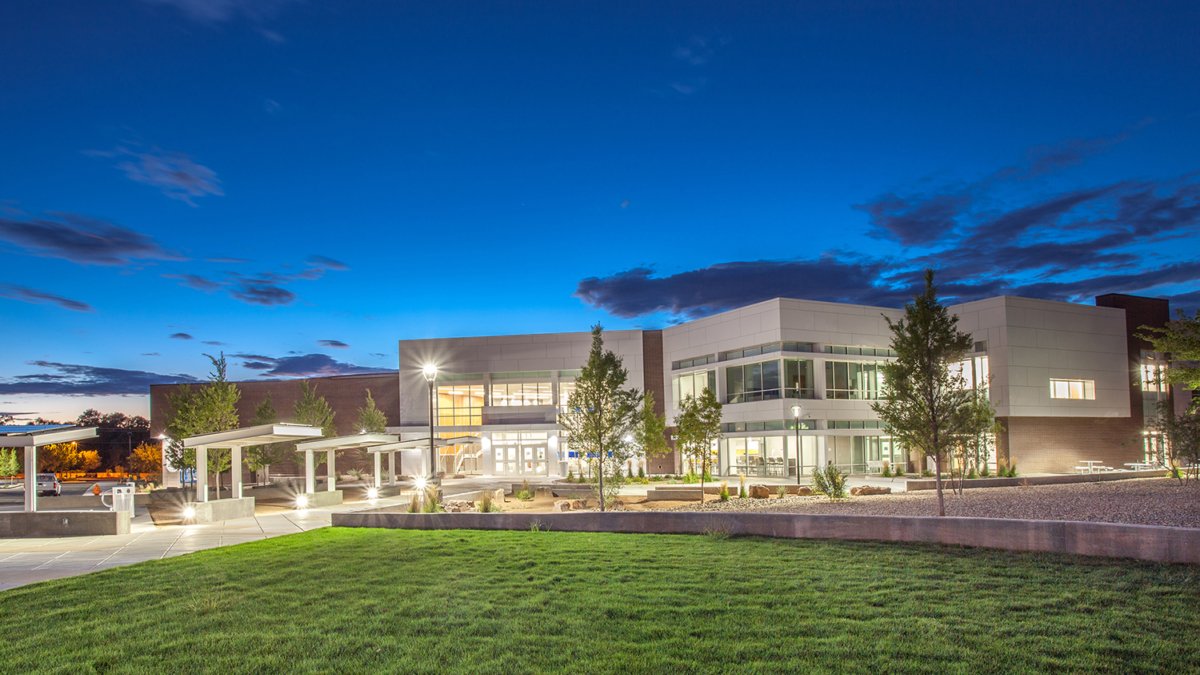
Campus construction is mostly a scheduling problem with a building attached, and the Santa Fe Community College District is where that discipline pays off. We build classrooms, laboratories, studios, student housing, athletic and community buildings, and the infrastructure behind them for colleges, public agencies and developers, and we organize the work around academic terms so that buildings are ready when the students are.
The Community College District plan covers about 17,000 acres south of Santa Fe, and it hosts the campuses of Santa Fe Community College and the Institute of American Indian Arts. The community college sits on a 366-acre campus about 12 miles southwest of the city center with about 4,027 undergraduates, and the Institute has a 140-acre main campus about 12 miles south of downtown. Two campuses of that size, side by side, produce a steady, varied and public flow of work.
Buildings for teaching, making and living
The scope on a campus spans many building types. Classrooms and laboratories need ventilation, power and data; studios for art, craft and performance need daylight, durable surfaces and storage; student housing needs life safety, acoustics and finishes that survive hard use. We also build library, administrative, athletic and community facilities, and we renovate older buildings to keep them useful.
The Higher Education Center at Santa Fe Community College opened in January 2015, an example of how a campus adds capacity in stages. Our education facility construction work follows the same approach: modest first phases that leave room for the next, and mechanical and electrical systems sized to grow.
Planning around terms, not around months
Academic calendars determine what is possible. Demolition, utility tie-ins and noisy work belong in summer and breaks; classrooms must be completed and commissioned before the term starts; and student housing has to be ready for move-in day, which is not negotiable. We build schedules that count backward from those dates and show the specific items that could threaten them.
We also meet with facility managers, department heads and, for the Institute, the people who run studios and galleries, because the people who will use a building often know details that drawings omit. A building's success is measured by use, and early conversations keep it practical.
Education and community buildings
Our education buildings include classrooms, labs, studios and lecture halls. Residence halls and apartments fall under student housing construction, a service with its own demands on schedule and durability. Smaller buildings that draw the community, such as galleries, workshops and small performance rooms, have their own acoustic and daylight needs that we coordinate with designers.
Developers who build near campuses for staff, students and visitors work under the same district plan, so apartments, small retail and offices appear alongside the college buildings. We keep that mix in mind when advising on sites and utilities.
District plan, county code and building code
The district plan was incorporated into Santa Fe County's Sustainable Land Development Code in 2016, so county land-use rules sit on top of the state building code. The 2021 New Mexico Commercial Building Code, which adopts the 2021 International Building Code as amended and took effect July 14, 2023, governs the buildings themselves, and the 2021 New Mexico Commercial Energy Conservation Code, effective January 30, 2024, applies to energy.
Public institutions usually add their own standards and approvals, from board action to procurement rules and project review. We read them with the owner at the start, ask about funding sources and reporting, and assemble a calendar of the approvals that will precede the first shovel.
Safety with students and visitors nearby
A campus is a public place. We separate construction from pedestrian routes, protect building entrances, keep emergency lanes clear and brief workers on conduct around students. Fences are placed with thought, and signs direct pedestrians to alternate routes. Work involving cranes, excavation or roofing is planned with the campus security office.
Where a building will remain in partial use, we protect occupied areas from dust and noise, keep egress paths intact and verify that fire alarm and sprinkler systems remain active. Our education institution projects always begin with this safety conversation.
What shapes a campus budget
Campus budgets are shaped by finishes, systems and phasing more than by structure. Laboratories and studios need specialized ventilation, power and water; housing needs durable surfaces and acoustic separation; and every building needs commissioning before it opens. Utility extensions across a large, spread-out district can also be a substantial line, and we ask the owner's facilities group early about capacity and tie-in points.
We also help owners decide what to build now and what to leave for a later phase. Shell space that is designed for future fit-out, mechanical rooms sized for growth and sitework that supports a second building all cost less when done in the first phase, and we price those choices openly so a board can weigh them.
Who we work for in the district
Our clients include public colleges, private institutions, local governments and developers who build housing and commercial space near campuses. Each has a different procurement process and a different tolerance for risk, and we adjust our proposals accordingly. Public sector owners prefer clear documentation and fixed pricing, while private owners often value speed.
Neighboring places have their own character. Rancho Viejo shares the district plan, and Santa Fe is the nearby city where many staff and students live. Both appear on their own pages.
Build for the next term
Tell us the building, the term it must serve and the approvals in hand. We will draft a schedule counted backward from the first day of class and price the work to match.
Questions Owners Ask
Can you finish a building before the fall term?
Often, if the start date is early enough and long-lead items are ordered in time. We schedule backward from the move-in or first-class date, identify the items that cannot slip, such as the permit, envelope and commissioning, and keep float for them. Owners should treat late funding as the largest risk to a fall opening.
How large is the district?
The Community College District plan covers about 17,000 acres south of Santa Fe, including the campuses of Santa Fe Community College and the Institute of American Indian Arts. The size means construction sites are spread out, and utilities and roads vary from one parcel to another.
Which rules apply to campus buildings?
County land-use rules, because the district plan was incorporated into Santa Fe County's Sustainable Land Development Code in 2016, and the state building and energy codes. Public institutions may add their own standards. We check each layer during preconstruction.
How do you build near students and classes in session?
We separate the site from pedestrian routes, limit noisy work to agreed hours, and keep building entrances and emergency access clear. For work inside an occupied building, we use dust barriers, negative air where needed and a communication plan with staff.
Do you build housing near campus?
Yes, from student residence halls to apartments for staff and local residents. Housing near a campus has its own timing, since move-in dates are fixed, and its own finishes, since use is heavy. We plan both from the first estimate.