
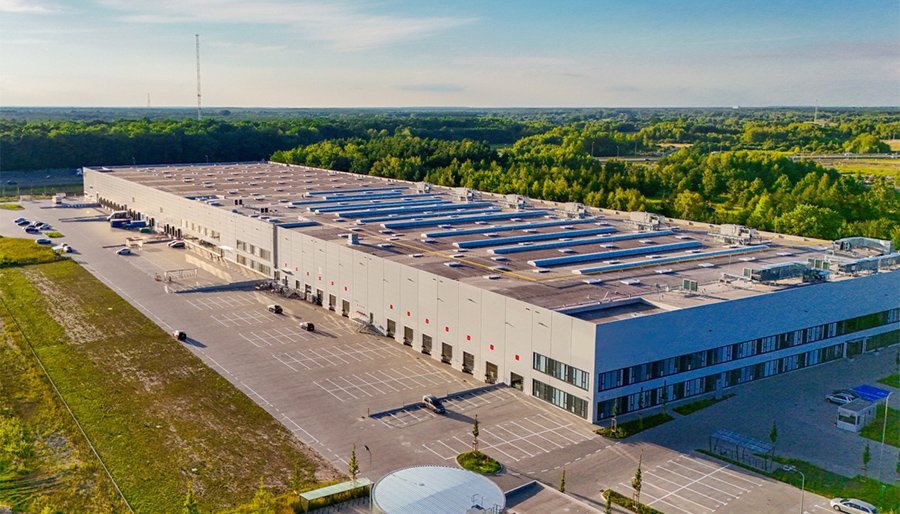
Logistics and Fulfillment Centers in Santa Fe and Northern New Mexico
Seasonal peaks, not averages, are what a fulfillment center must be built for. An operation that handles a quiet January can be overwhelmed in December if the building cannot absorb extra labor, extra trucks and extra conveyor, and the cost of discovering that is paid in missed orders. We build logistics and fulfillment centers for owners and operators who want the building to carry their busiest week as comfortably as their slowest.
The shape of retail has been changing in this region as elsewhere. Santa Fe Place, an enclosed one-floor mall of about 569,500 square feet with roughly 3,261 parking spaces on Cerrillos Road, has been the subject of announcements for apartments, a hotel and a bookstore in the years after 2021. Where shoppers once drove to a mall, a growing share of orders now travel from a shelf to a doorstep, and local operators who deliver across northern New Mexico need space that suits that work.
We approach these buildings quietly and practically. We will study how an order moves through your building, where people stand, what the conveyor needs, and how much power and data the equipment will draw. Then we build a shell and a set of systems that serves the operation and can be changed as it grows.
Flow, labor and equipment
A fulfillment center is organized around the path of an order: receiving, putaway, picking, packing and shipping. Each step has different space and equipment needs. Some operations rely on mezzanines and pick modules, others on automated storage, others on simple shelving and carts. The building must accommodate the chosen method, including its floor loads and clear heights.
Labor is a design factor as well. People need parking, break rooms, restrooms and a pleasant place to work, and a site that is easy to reach by car or transit attracts workers. The Rail Runner Express links Santa Fe to the Albuquerque area, and its Santa Fe County/NM 599 station sits in the median of I-25 at the NM 599 interchange, which may matter for an operation that draws employees from several communities.
Where the work is likely to settle
Last-mile delivery favors sites near population and arterials. The southern side of Santa Fe along Cerrillos Road and St. Francis Drive offers access to the highways, and the planned villages of Rancho Viejo, which projected 8,000 to 10,000 homes over the next 50 years with about 1,400 houses built as of a June 2023 report, add demand on the south side of the city.
The same parcels must also respect their surroundings. Santa Fe's historic districts are not places for large fulfillment buildings, and neighborhoods outside the districts often ask for lower heights, screened docks and limited night operations. We study each parcel against the likely objections and shape the building to answer them before they are raised.
A shell that can change
We advise owners to treat the shell as long-lived and the equipment as short-lived. The structure, slab, sprinkler system and power service should be generous enough that the operator can change racking, conveyor and automation without rebuilding. We leave floors flat, conduits ready, roof structure able to take extra equipment, and dock walls with spare knockouts.
The shape of the building matters too. A rectangular box with docks on one or two sides is the most flexible plan, and the choice between a distribution center layout and a fulfillment layout often comes down to the size of the item, the number of orders and the speed. Our fulfillment and logistics center construction work reflects that analysis.
The neighboring building types
An operation that grows may need more than one kind of space. A regional carrier might add a cross-dock for transfer freight, and we explain how those buildings work in our discussion of truck terminals and cross-dock buildings. A retailer might combine fulfillment with a showroom or a returns area.
Owners in retail and in logistics and distribution tend to ask how a fulfillment building differs from an ordinary warehouse. The short answer is power, data, labor and flexibility: a fulfillment center uses more of each per square foot, and its design reflects it. Operators that supply vehicle plants can also read about automotive and EV plant construction.
Building to a launch date
A fulfillment operation usually has a launch date tied to a season or a contract. We work backward from that date, setting the site work, the shell, the interior fit-out and the equipment installation in sequence. The installers of conveyor and storage systems need access to a finished floor, power and a conditioned building, so those milestones are scheduled with them.
Equipment and electrical gear can have long lead times, and permits can take time. The 2024 New Mexico Mechanical Code is listed as effective August 1, 2026, with permits under the 2021 or 2024 edition until January 1, 2027, so projects permitted in the coming months should agree on which edition to follow. We resolve this with the design team and the building official early.
What the building costs, and what the equipment costs
The shell of a fulfillment center is often less than half of the total investment. Racking, conveyor, sortation, lighting, data cabling, and the electrical service that feeds them can equal or exceed it. We help owners separate the construction contract from equipment purchases, and we coordinate the two so that nothing is installed twice or left out.
Clear height, slab quality, sprinkler design and the size of the office and break areas are the main drivers within the shell. We offer options and show the cost of each, so you can decide where to invest. A modest increase in clear height or power capacity at the start often costs far less than a retrofit later.
Tell us how an order moves
Describe your orders, your volume and your peak season, and we will sketch a building and a schedule that fit. We will also tell you honestly if a simpler warehouse would serve you better.
Questions Owners Ask
How is a fulfillment center different from a warehouse?
It is designed around the speed of picking and shipping individual orders, not the storage of pallets. That means more power, more data, more labor space and often a mezzanine or automation. The structure may look similar, but the systems are more demanding.
How much clear height do I need?
It depends on the storage method. Pick modules and mezzanines use height efficiently, while pallet racking uses it in a different way. We compare the cost of added height against the storage gained, and we consider the sprinkler design that goes with it.
Can I build in phases?
Yes. A common approach is to build a shell with the full slab, utilities and docks, then fit out the interior in stages. We plan so the second phase can be built without disturbing the first.
What approvals does a large fulfillment building need?
Zoning, site plan, drainage, building and fire approvals, and sometimes traffic review. We assemble the submittals and meet with the reviewers, so surprises come early.
Can you work around an operation that is already running?
Yes. We phase the work, separate it with temporary barriers and agree on hours, routes and safety rules. Many owners cannot stop shipping during an expansion, and we plan accordingly.