
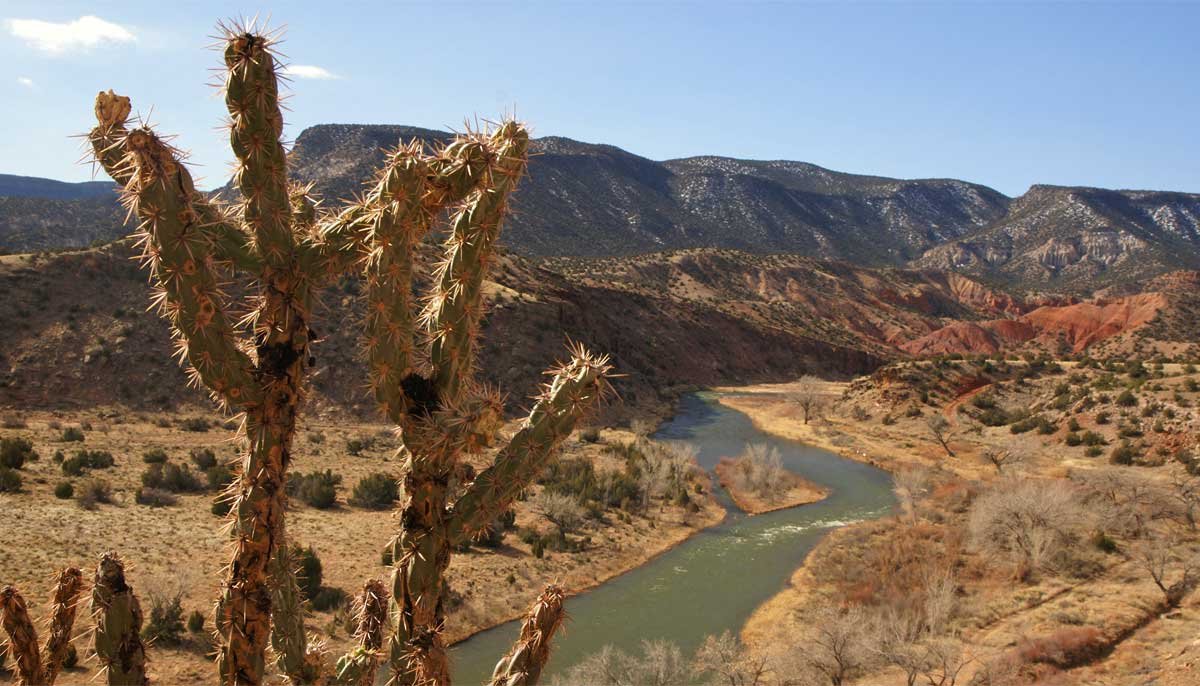
Construction in Abiquiu, New Mexico: Remote Sites Along the Rio Chama
Fifty-three miles of road separate a Santa Fe supplier from an Abiquiu job site, and that distance is the first thing we price, schedule and plan around. We build small commercial, visitor-serving, institutional and utility-related structures in and around Abiquiu, and we do it with an honest account of hauling, crew travel and the weather that can interrupt both.
Abiquiu sits at 6,172 feet, had 181 residents in the 2020 census and is about 53 miles north of Santa Fe. The Georgia O'Keeffe Home and Studio is in Abiquiu, and Ghost Ranch, home of the Ruth Hall Museum of Paleontology, is a nearby point of interest. Buildings for people who come to see such places, whether guest lodging, small food service, galleries or visitor facilities, need to be good neighbors, durable and easy to maintain far from the city.
The Rio Chama also shapes the work. Abiquiu Dam, completed February 5, 1963 by the U.S. Army Corps of Engineers at a cost of $21.2 million, is 354 feet high and 1,800 feet long and is used mainly for flood control, with irrigation, municipal water storage and hydroelectric generation. Its reservoir has a full-storage capacity of 1,369,000 acre-feet and has never filled; the record high was 402,258 acre-feet on June 22, 1987. For a builder the point is practical: this is a river and reservoir landscape, and drainage, soil and floodplain questions should be settled before a design is final.
How we reach and supply the site
We mobilize to Abiquiu from Santa Fe and price the trip as a line of its own. For small projects we bundle trades into fewer, longer visits, and for larger ones we propose a staging area, a temporary storage container and a supply schedule so the crew is not waiting for a forgotten fitting 53 miles away. The owner sees the cost of distance, and sees how we hold it down.
Because the nearest large supplier is far, we carry a modest stock of commonly needed fasteners, anchor bolts, sealants and connectors, and we confirm critical deliveries a day ahead. A missing part on a remote site costs a day of crew time, and a short list kept in the truck is cheaper than a day.
A calendar built around the drive and the weather
On a remote job the schedule has to include the days a road or a delivery fails. We add float for weather, plan the critical deliveries for the middle of the week and avoid placing concrete or setting roofs at the end of a storm forecast. Where the building is for a seasonal business, we work backward from the date the owner wants to open.
Long-lead items such as windows, doors, mechanical equipment and custom millwork go on the schedule first. Our long-lead procurement planning places orders while the drawings are being finished, and our phased construction approach lets an operating property stay open while we work on part of it.
What we build and repair
Typical assignments here include guest lodging and cabin-scale buildings, small retail and gallery spaces, restaurants and kitchens, studios and workshops, community buildings, storage and equipment buildings, and the repair or reuse of older adobe-style structures. The work calls for good renovation and adaptive reuse judgment, since older walls have to be understood before they are altered.
Water, wastewater and drainage are often the real scope. Many sites depend on wells, septic systems or small community systems, and our site development and utilities group helps the owner confirm what is available before the building is sized.
Water, soil and the floodplain
A river corridor is not just a view. Soil near the Rio Chama can be sandy, silty or cobbly, and groundwater and flood risk vary with location, so we recommend a geotechnical investigation and a drainage review during preconstruction. The foundation, the finished floor elevation and the grading follow from what they find.
The scale of Abiquiu Dam and its reservoir is a useful reminder that water in this valley is managed, shared and sometimes scarce. Any plan to draw water, discharge it or alter a drainage path should be checked with the agencies involved before design is final, and we help the owner prepare a clear description of the proposal.
Why remote work needs a firm number
Remote projects carry costs that city projects do not: travel time, temporary storage, the supply trips and the weather days. Owners sometimes assume these are small, and they can be. We show them separately and tell the owner which would be avoided by different timing or scope.
We also advise on the choices that reduce lifetime cost at a distance. A durable roof, a simple mechanical system, and materials that need little upkeep make sense where every repair visit costs travel as well as labor. Our preconstruction estimating compares those options in the concept phase.
Respect for a quiet place
Our approach to Abiquiu starts with the recognition that people travel here for the stillness and the land. We keep the footprint small, restore disturbed areas, limit lighting, manage noise and dust, and clean the site daily. The owner of a guest property in particular knows that visitors will remember a messy neighbor, and we try to leave none.
Rural conditions are much the same in Ojo Caliente and Chimayo, and what we learn on a job in one tends to help in the others.
Owners who build in this valley
Hospitality owners, nonprofit and cultural organizations, small businesses and public agencies are the usual owners. Hospitality groups care about guest comfort and maintenance, while public sector owners care about bidding rules, documentation and long service life.
Whichever the owner, the closeout package includes record drawings, warranties and a maintenance outline, so the next person responsible for the building knows where the shutoffs are and what each system needs.
Plan your Abiquiu building
Tell us the use, the parcel and the date you hope to open. We will bring a short list of questions about water, access and review, and then a realistic outline of cost and schedule.
Questions Owners Ask
How much does a 53-mile haul add to a small project?
The amount depends on the number of trips, the size of the loads and the trades involved, so we do not quote a rule of thumb. We show travel, mobilization and supply trips as separate lines and then look for ways to reduce them, usually by grouping visits and ordering early. Owners can then compare cost of distance against cost of design changes.
Is flood risk a real concern near the river?
It can be, depending on the parcel. We recommend that the owner review flood information for the specific site and that the design team consider grading and finished floor elevation. A geotechnical and drainage review during preconstruction is a modest cost compared with correcting a building that sits in the wrong place.
Can you build for a seasonal business?
Yes. We work backward from the opening date and set milestones for permit, long-lead orders, enclosure and finishes. When a date cannot be met, we say so early and propose phasing, such as opening a first set of rooms while later work continues.
What if the site has no municipal water or sewer?
Then the water source and wastewater system become the first design decisions. Wells, tanks, septic systems and small shared systems each have approval paths and costs, and they limit how many rooms or seats the site can serve. We bring this analysis into the concept so the building is sized to what the site can support.
How do you handle winter?
We schedule exterior concrete, framing and roofing for the warmer months wherever possible and we price winter protection when it cannot be avoided. At 6,172 feet, cold limits for concrete and masonry are real, and we note them on the schedule.